by Philip LaVoie
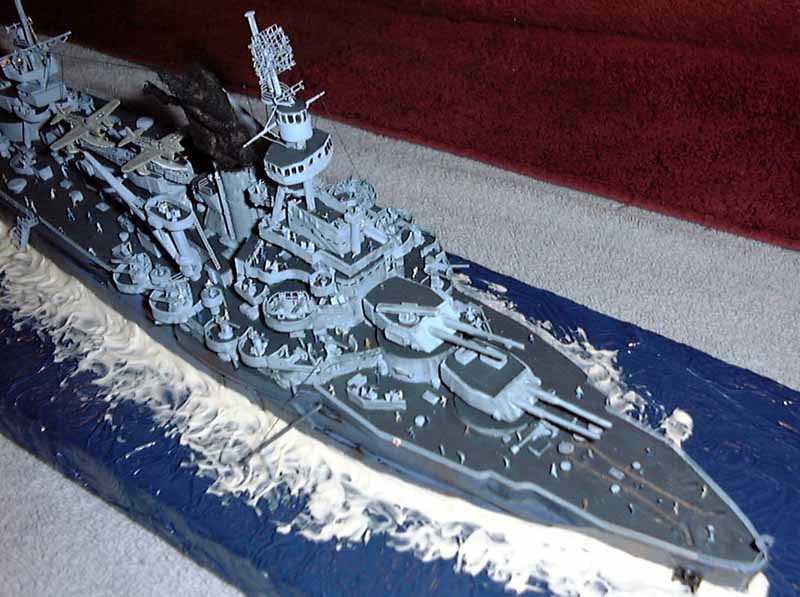
1/350 USS Arkansas BB-33 (Iron Shipwright)
In my continuing quest of building all the ships to carry the Arkansas name, my second USS Arkansas is also my first attempt at a full scale resin kit. After discovering I had a little left over from my income tax refund I took the plunge and purchased the resin USS Arkansas battleship kit from Commander Models, Inc. This can be a difficult kit to find, and I believe they cast this one when I ordered it. She retails between $245 - $275 which is a significant investment on my little budget. But, the Arkansas is a cool little battleship.
The Arkansas was one of two Wyoming-class battleships. She served in WWI and was the oldest battleship to serve in WWII. With a main armament of 12 12” guns in 6 dual turrets, the most main turrets of any US Warship, visually alone she’s worth adding to one’s collection. She had a distinguished career including taking part in the D-Day invasion and once served as flagship of the Atlantic Fleet. Her end came as part of the test fleet during the nuclear weapon tests near Bikini, and you can dive to her remains to this day. The model represents a late refit configuration in 1944.
I wasn’t sure what to expect being I’ve never ordered one of these resin kits. The 17 pages of instructions arrived separately from the kit in a brown envelope. From other reviews I’ve read I was a bit anxious on the clarity of the instructions that came with those kits, but happily these are well done and fairly easy to follow.
Soon after, the model itself arrived. The ship is cast full hull, and I have to say the workmanship is absolutely beautiful measuring in at 19” long and 3 3/4” at its widest point. There were some minor chips in some of the weapon shields and a few little holes to patch, but overall it was a good cast. Being I’m building all my ships waterline, my first venture was to figure out how to saw this chunk of resin in half. Let me tell you, it was a full day project. I tried every kind of cutting device on this thing, including a Reciprocating saw, but the best thing that worked was the blade from a hack saw that I held in a gloved hand and worked my way through the hull one half inch at a time. Thank goodness the resin never cracked, its pretty sturdy stuff.
The fully cast hull makes construction a bit easier, but a pain to paint. There are no painting guidelines in the instructions, but she wore a measure 22 camouflage pattern at one time which is basically a light blue or bluish-gray on all the vertical sides, a dark navy blue on the lower hull and a dark gray on all flat surfaces. After spraying the main hull I chose a light blue color and sprayed over the deck, and then hand brushed dark gray around all the molded-on details. By the end of the war the Arkansas was showing her age, so I heavily weathered the ship with washes of black and rust here and there. I painted all the other sections as they were completed with the light blue and dark gray, and brushed a white pattern underneath the main gun’s barrels.
Many of the smaller pieces were covered in flash and were difficult to clean at times. You have to be careful or the thin resin can easily snap. I decided to replace the 20mm guns with PE to make them more accurate looking, but I didn’t want the two dimensional brass bases. So, I chopped the bases from the resin guns and attached the brass barrels, then added shields and other details. The quad 40mm guns had brass shields and sights attached. The searchlights were really messed up and were not repairable, so I scratch built a couple. I also used the newly released L’Arsenal 25-Man Flotation Rafts. I think the three most numerous items on world war naval ships were sailors, guns and balsa life rafts. The only parts missing from the kit were the MK51 directors and their tubs. Although I wrote to them requesting replacements, I never received them and ended up scratch building the tubs and detectors as well.
One major construction step missing from the instructions concerns the two protrusions at the stern of the ship that held a couple extra 20mm guns. Fortunately, these parts are included, you just have to know to attach them. Also, there’s no reference to the six side guns on the ship. Their turrets are cast in the hull though, so all you need to do is add the barrels. From photographs it seems they kept the six forward ones intact but had removed any barrels at the stern of the ship. You will also have to supply anchor chain as none came with the kit.
It would be very beneficial to study as many photographs of the Arkansas as you can find, as well as other model build-ups. They gave me ideas on accommodation ladder placements and extra 20mm mounts. I also changed up the radar configuration from that in the instructions. Fortunately, their photo-etch brass includes many extra parts, plenty for all my detailing needs.
The rest of the construction went well. I mounted two aircraft on the catapult as seen in many photographs, used stretched sprue for the rigging and added some PE figures for the crew. The smoke is spray painted cotton and the base is my usual sprayed aluminum foil covered with Future floor wax and white bathroom caulk. The small auxiliary craft coming along side was a spare that came with the kit with some extra detailing added. I had purchased one of those 1/350 scale Diecast Navy Blimps by Model Power at one time and thought it would look cool floating in the background, so I detailed it out and attached it to the back of the display case.
Overall, the kit seems to be well cast, especially the hull, and the instructions are pretty clear. I’ve seen some earlier pics of this kit, and they seem to have upgraded it and made it more accurate. There is a lot of cleanup to be done on the smaller parts, and some small parts may have to be scrapped all together so hone your scratch building skills. It was expensive, but resin kits are made very accurate and you’re not only paying for a subject not found in plastic but all the work that was put into creating the kit. I’m quite pleased with the outcome. It’s a great second edition to my Ships of Arkansas project, now on to the third!
