by Jens Hansen
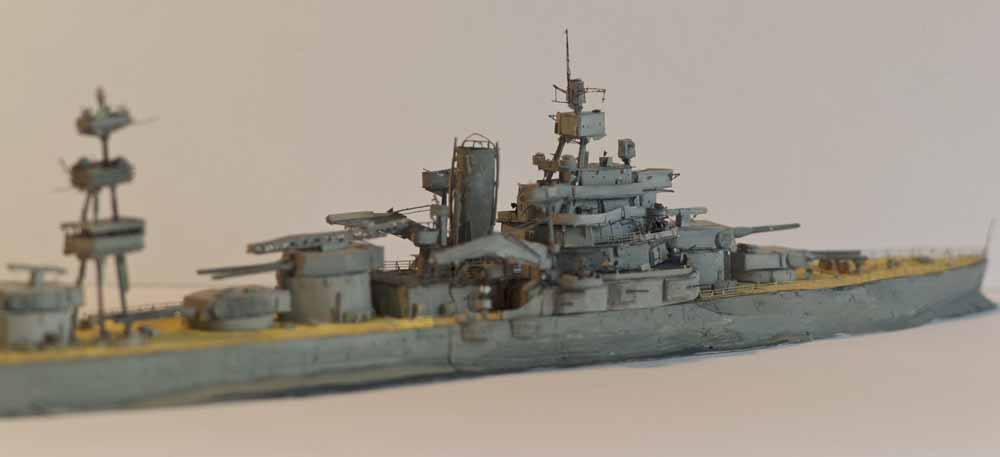
1/700 USS Arkansas BB-33 (Scratchbuilt)
By 1910 the US sought to expand on their naval strength as as the arms race raged on in europe, the united States were very much being left in their wake literally. The navy sought modernisation and reform to push ahead in the field of naval technology and innovation, yet the Wyoming class ships still represented conservatism, choosing the tried and tested 12inch calibre instead of the proposed 14 inch. So technically she became outdated in terms of calibre within a few years of her construction.
The Arkansas played her part in both world wars, being part of the US Squadron Battleship Division one of the British Grand fleet, whilst two and a half decades later she played a prominently supportive role in escort, whilst seeing action in the later half of the war during the invasion of Europe in 1944, and the final push in the pacific in landings on Iwo Jima and Okinawa.
Post war the Navy Department saw no further use for the aging hull which had served admirably for near on three and half decades, consequently she was earmarked to be a test vessel in the Bikini atoll nuclear tests, where she finally sunk after being subjugated to the two nuclear tests ABLE and BAKER, this tropical paradise ravaged by the hands of man came to be her final resting place.
Building the Arkansas from scratch in 1/700 was a fascinating but yet a daunting prospect, the build took circa 3 months periodical work, this was actually my first ever scratch build of a battleship in comparison to the majority of my projects which encompass smaller more obscure ships. Hence the fact that theres so much more to include and create within the limited confines of the vessel’s dimensions and scale, yet this is not a downside instead it adds to the greater challenge of scale modeling.
It’s also a much more complex build, structurally anyhow, compared to my previous projects such as the HMS Ajax and Clare. Just by getting the sheer measurements and the dimensions of the hull to an acceptable standard, especially when working in such a small scale, were mistakes are naturally magnified. The foundation for the build is what I’ve come to use time and again, trusty balsa wood. Whilst the actual superstructure is composed of sheet paper, card and plastic, which are basically used by layering each deck individually beforehand, which then come together (or at least they should) to create the greater superstructure. The build was supplemented by WEM’s, ever excellent accessories for smaller detailing, (e.g. AA weapons, hatches and ladders).
The Arkansas was an interesting hiatus from building smaller vessels and who knows maybe one day I’ll return to the perils of larger warships.
