by Robert Apfelzweig
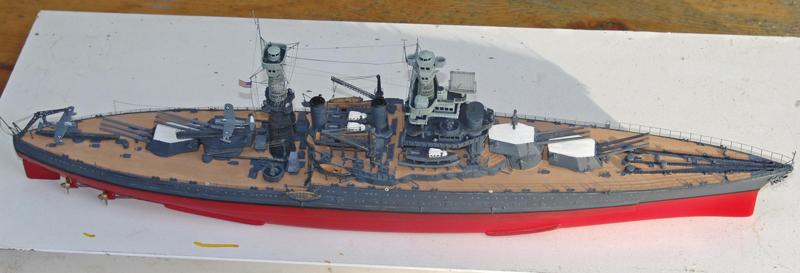
1/350 USS California BB-44 (Yankee Modelworks)
A few months ago, a major internet hobby company offered a number of 1/350 resin kits for sale at irresistible prices, and so I purchased a model of a battleship I have wanted to build for nearly half a century. This USS California is actually my first resin kit, and it presented me with all the problems more experienced modelers have had to deal with for many years. The upper and lower hull halves lined up perfectly at bow and stern, but I found to my chagrin that, with the starboard sides mostly aligned, the lower hull was about 2 mm narrower than the upper hull amidships. After gluing the two halves together I solved this problem by adding a lower "armor belt" of styrene sheet to the lower hull and dutifully filling with putty and repeatedly sanding away the excess to leave a smooth and largely blended finished hull. I found that my Squadron brand green putty nicely softened and spread very thinly when moistened with a mixture of acetonitrile and isopropanol (I'm a biochemist by profession) . The resin turrets had false barbette cylinders beneath them that had to be cut or sanded away, but fortunately I have a table-mounted belt sander that made this job easy, a process also needed for several of the bridge decks which were overcast for thickness. The kit came with rather crude hand-drawn instructions that were barely sufficient for assembly, and the extensive brass photoetch set had a number of parts that were not identified in the instructions and so were subject to some uncertainty as to exactly where they went and what they were. Some scratchbuilding of mast components (such as the supports beneath the mainmast's searchlight platforms) was necessary. One annoying feature of this brass set is that there are way too many attachment points for many pieces, especially the rails, which made them tedious to clip off with fine scissors. The instructions were, however, up-to-date in describing how to paint the USS California as she appeared when sunk at Pearl Harbor -- Navy Blue 5N for the hull, upper decks and vertical surfaces with the much lighter 5L for the upper bridge, cage masts and fighting tops. Additional documentation for the white turret tops (used for the benefit of its floatplanes to identify the ship from the air without the aid of their radios) was obtained online. I used water-based Pollyscale 5N and 5L paints (primarily airbrushed) and oil-based WEM Colourcoat 5-N for many of the brushed smaller pieces and necessary touchups. The wood decks were mostly airbrushed with a mixture of Tamiya Desert Yellow, white and brown, and the tops of turrets 1, 2 and 4 were Tamiya flat white. This heavy kit came with an extensive set of "fine white metal" parts, most of which were so poorly cast that I couldn't use them. I purchased 2 sets of Veteran 5-in. .25 cal antiaircraft guns, 14-in. brass main battery barrels from Master Models, the two Kingfisher floatplanes from Trumpeter and fashioned the 5-in. .51 cal. casemate gun barrels from the 5.25-in. plastic gun barrels I had removed from my HMS King George V when I replaced those with Master Models brass barrels. The original four white metal 3-in. .50 cal antiaircraft gun mounts were passable and so I used these but made the gun barrels from stretched plastic sprue, which I also used for the rigging. I used the rather heavy white metal catapult provided for turret no. 3 (the stern catapult was brass photoetch) but drilled several more holes through it to give it a more lattice-like appearance. The anchor chains are 23 link-per-inch copper from Model Shipways (mislabeled, perhaps by someone with dyslexia, as 32 links-per-inch) and were blackened with gun bluing purchased from a local sporting goods store.
The most difficult assembly in of the kit was the cage mainmast. There are three circular horizontal mesh platforms that are supposed to fit snuggly inside the rolled up cage mast, their ladder slots all aligned. Unfortunately, when placed as the instructions stated, they were slightly too wide, so that the mast, when rolled up, could not complete a tight seam. After several hours of frustration (well, the printed instructions DID say to be patient and take my time) I finally had to move the platforms either one level up or down to wider positions in order to close the mast seam with superglue. Getting the ladders inside the rolled up mast and properly positioned was another effort altogether. One interesting feature of this model, which dutifully represents the California as she appeared at Pearl Harbor on Dec. 7, 1941, is the odd location of the rather ungainly "bedspring" CXAM radar antenna. The other battleships at Pearl Harbor that had this radar type (and the USS Arizona was to receive it the week following Dec. 7, but of course never did) had it positioned on the roof of the foremast fighting top, but on the California it was placed at the upper front of the bridge where the main rangefinder had been, the latter being moved to a new position atop main gun turret No. 2. Photos of the California taken during and after the attack show that this is the correct location for the radar. This being a resin kit, with everything solid and immobile, the CXAM radar is the only thing that can move, rotating on the axis where connected to its white metal holder. I am quite taken with this ship -- I have always loved that clipper bow, which seemed to imply that battleships of this class (and of the others with similar bow designs) were actually faster than they were. The USS California was an admiral's flagship at the time of the Pearl Harbor attack, and was preparing for inspection that fateful day -- hence her watertight integrity was severely compromised, and two torpedoes and two bombs were enough to sink her at her birth. She was refloated in March 1942 and in June sent to Puget Sound for a complete reconstruction that left her looking nothing like her previous appearance, and was back in action in the Pacific island-hopping offensives by June 1944. She was able to exact some revenge against the Imperial Japanese Navy at the Battle of Surigao Strait in October 1944, and later took part in the invasion of Okinawa. She was placed into inactive reserve and mothballed at Philadelphia in 1946 and scrapped n 1959, along with her sistership USS Tennessee (BB-43).
