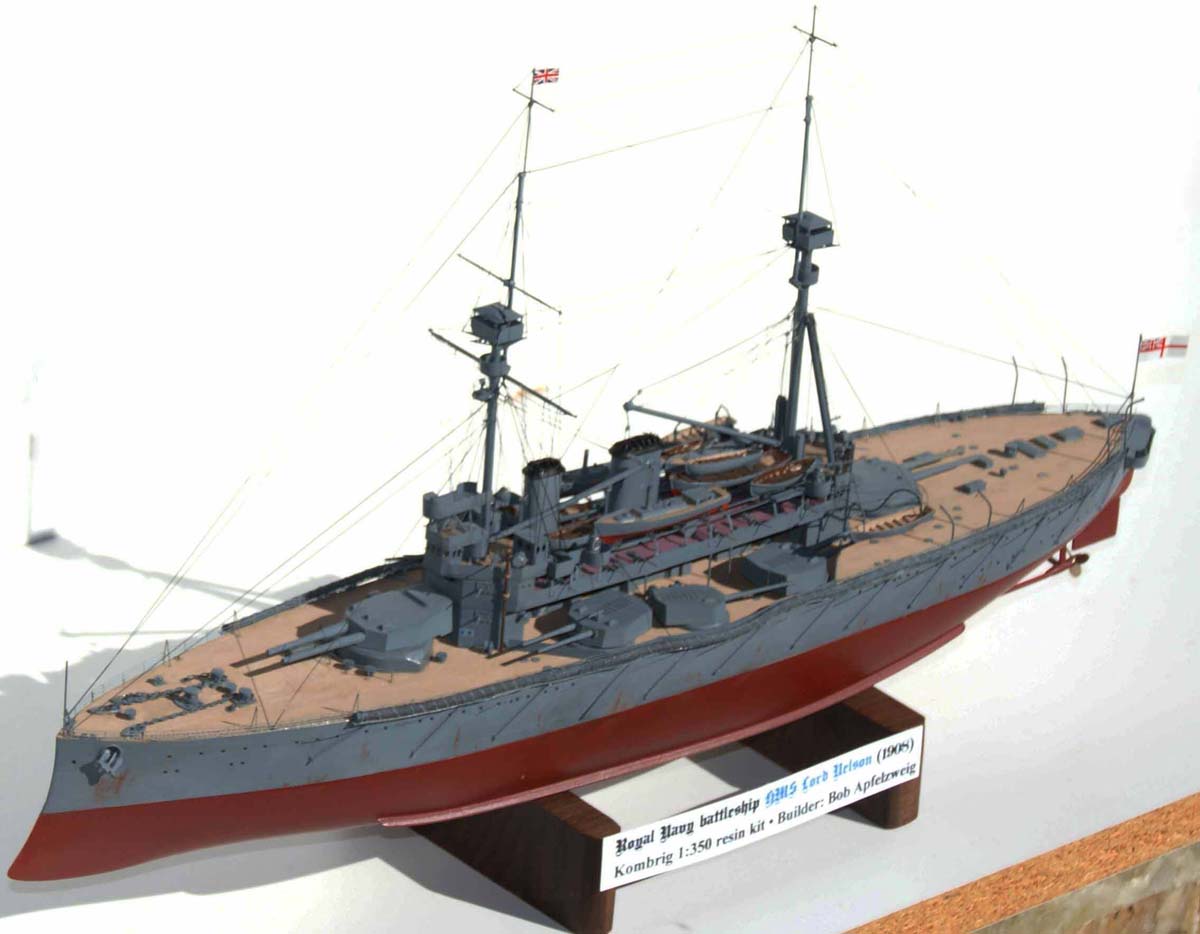
1/350 HMS Lord Nelson (Combrig)
|
by Robert Apfelzweig |
1/350 HMS Lord Nelson (Combrig)
The Russian model company Kombrig (or Combrig) has been releasing a considerable number of unusual naval models, primarily of the 1890 - 1918 period, with capital ships from the Imperial Russian, British, German, French and Japanese navies. I purchased a number of their recent 1:350 scale resin kits this year from a major (in the USA) online distributor, and the HMS Lord Nelson is the first of these kits that I have assembled.
Looking over this kit and those of my other Kombrig models, I would like to make a number of remarks. The hulls (nearly all are offered as full hull or waterline versions; I purchased the former, which have separate upper and lower hull halves) are very well-formed with clean deck apparatus and planking; the turrets are well-formed and the resin gun barrels generally straight and well cast. The problem with these kits is (1) the photoetch sets are limited and undistinguished; no railings are the norm and all parts are 1- or 2-dimensional (there is no embossing for a 3-dimensional appearance), (2) masts and yardarms are not included and the builder is tasked with providing these on his own, with a list of sizes and lengths needed that can usually be made from brass or plastic rods. However, often there is no indication in the limited assembly instructions as to which mast part goes where. (3) The photoetch and resin parts are illustrated in the assembly instructions but not numbered, and often are only referred to in these diagrams as "PE" without any clear indication of which particular PE part is to be used (i.e., with multiple ladders or similar parts). A finished, assembled image of the whole model, or parts thereof, would be very helpful. (4) There are often only indistinct indications of precisely where certain parts are to be connected, since (at least with this first Kombrig model) there are no holes, pins, notches or cast outlines to indicate precise positioning.
Specifically for the HMS Lord Nelson, there is a complete absence of anti-torpedo nets, booms and support grates along the hull, despite these being illustrated in the instructions and on the rather poorly reproduced photograph that adorns the plain white cardboard box in which the kit comes. I had to scratch-build all of these, and was fortunate in having some surplus netting from my recent Hasegawa aircraft carrier Akagi that I was able to cut up into narrow strips. As with my previous builds of the HMS Dreadnought and HMS Queen May, the rolled up nets themselves are provided by lengths of mesh shoelaces that are circular in cross-section. The Kombrig kit also does not provide enough small boats, so I used a pair of extras from my (now rather impressive) collection of spare parts for the two that are suspended on davits just astern of the rear 9.2-in. gun turrets. As built, the Lord Nelson and its sistership HMS Agamemnon had 24 12-pdr. (3-in.) QF guns distributed along the boat/gun deck above the man deck, with four in the forward bridge that, on the model, are concealed behind armored doors, with only the barrels protruding. The Kombrig illustrations, however, show that all 8 gun turrets should have a single 12-pdr. on their roofs, but only 24 such guns, or barrels, are provided. After doing some online research I couldn't find any consistent evidence for rooftop guns except on the forwardmost 9.2-in turrets, and Kombrig provides several smaller guns (presumably 3-pdrs.) and mounts that I decided to place there. Most photographs of the ship were taken during World War I, by which time those rooftop guns may have been removed, and those on the boat deck partially concealed by splinter shields (a feature not included in the kit) that curve beneath the small boat and motor launch support lattice. I used black plastic stretched sprue for the rigging; Kombrig provides no painting recommendations, so I chose Tamiya Wooden Deck Tan (XF-78) for the main deck, Light Gray (XF-66) for the upper hull, guns and superstructure, and a spray can of water-based Liquitex cadmium medium hue 2 for the lower hull. The flags were also from my spares collection (Kombrig provides none).
The two ships of the Lord Nelson class were the last predreadnought
battleships built for the Royal Navy, and the first to fully eschew the
6-in. secondary gun in favor of the heavier 9.2-in. battery -- a feature
that made them, in effect, "semi-dreadnoughts". In practice, however,
the shell splashes from both the main 12-in. and the secondary 9.2-in.
guns were virtually indistinguishable, making such an armament scheme of
limited usefulness. Their construction was delayed while they awaited
delivery of the 12-in. main guns, which went instead to the revolutionary
HMS Dreadnought (building at the same time), so that the Lord Nelson and
Agamemnon were actually completed after the launch of HMS Dreadnought and
so were instantly obsolete. During World War One they served as artillery
platforms in the Dardanelles campaign but saw little other combat and were
scrapped in 1922 (Lord Nelson) and 1927 (Agamemnon).
