by Joe Poutre
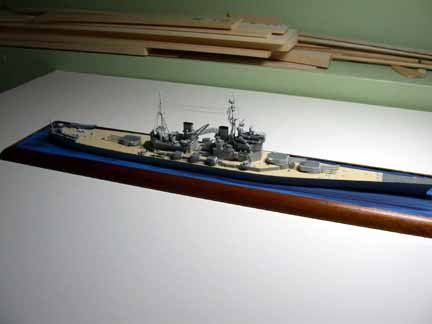
1/700 HMS Temeraire (Fujimi and Tamiya)
Before WW2, the Royal Navy had planned a follow-on class of battleships after the KGVs. Armed with nine 16" guns, the Lion class was to be the equal of any navy's most powerful warships. But having laid their keels, the RN realized they could not afford these ships.
However, the United States had a surplus of new battleships building. The last two Iowa class, Illinois and Kentucky, had been halted only partially completed in favor of aircraft carriers, freighters and landing ships. RN engineers examined the ships and reported that Kentucky could be completed armed with the new RN 16" guns and other armament and equipment, so that a new battleship could be had for the price of a cruiser. FDR agreed to turn over the incomplete ship to the UK, clearing a slipway for a new Midway-class CVB.
RN naval architects and engineers adapted the barbettes to take the new model 16" triple turrets, and reworked the 5"/38 locations for RN" standard 5.25" mounts. The superstructure was to be completed in a design similar to the KGV class.
The former Kentucky, now HMS Temeraire, was re-launched in June 1945, but would remain uncompleted due to the end of the war. Only HMS Vanguard would be completed, reducing the once-mighty fleet of Royal Navy battleships to a solitary vessel.
Temeraire sat in mothballs with the remaining KGVs until late 1946, when the Soviets launched the first of three 70,000 tonne 16"-armed battleships, followed by two 12"-gunned Kronshtadt type battlecruisers. The West needed to combat these new threats, and so the battleship would serve for one more war: a long, cold one.
The US retained their four Iowa class, and considered rebuilding the South Dakota and North Carolina classes, but determined the latter would not be cost-effective. Despite the threat of the Kronshtadts, the Alaskas were scrapped, as design studies established the new Des Moines class a match for the Soviet BCs, and much less manpower intensive.
Italy was allowed to repair and return Vittorio Veneto and Littorio to service, France completed Jean Bart and even considered restarting Gascogne, and Japan was allowed to restore Nagato, which would be rebuilt to a modified design as the first BBG. Turkey sent the pre-WW1 battlecruiser Yavuz to West Germany for refurbishment and updating, and also took over the USS (District of) Columbia, the captured-and-converted former "pocket battleship" Deutchland. Even Chile and Brazil joined in, the former paying the UK to have Almirante Latorre updated, and Brazil sending Minas Gerais to a US shipyard for an overhaul and upgrade.
In the UK, work on Temeraire was restarted, while the last KGV class, HMS Howe, was given an austere reactivation until Temeraire could be completed. Howe completed only one deployment, essentially a shakedown cruise to the Caribbean, before being paid off a month prior to Temeraire's commissioning.
Temeraire had undergone further redesign, the 5.25" mounts replaced by six new dual-purpose twin 6" mounts, and most of the lighter AA weapons left off.
The last battleships occasionally exercised together, culminating in 1955 with Operation Steel Curtain, a show of force by the Western allies. HMS Vanguard sailed with USS Iowa and Wisconsin, Jean Bart, Littorio, Vittorio Veneto, and Yavuz in the Bay of Biscay, while in the Pacific HMS Temeraire joined her half-sisters USS New Jersey and Missouri, plus Richelieu and JMSDF Nagato off Hawaii. These were as much photo ops as battle exercises, to demonstrate that the West would have the firepower to match the Soviets in both oceans.
And the model's story:
On another website, where odd-minded people like myself propose alternate histories, and build models of what-if planes, tanks, ships, and other subjects, there appeared a float-plane Corsair. An RN one, no less. It caught my eye, and my imagination, and I decided that plane needed a ship to go under her. But what ship?
In my collection of old kits I found a Fujimi USS New Jersey, veteran of many displays for the Battleship New Jersey Historical Museum Society. It had been grabbed by many small hands, hence was missing many parts. (This kept the hands off the larger, very expensive, hand-crafted models.) I had recently traded for parts of a Tamiya Rodney and KGV, and a plan took shape.
Off came most of the NJ's superstructure, replaced by a mixture of the KGV, Rodney, and styrene. (The hull of the KGV and the superstructure of the Rodney are to join up in the future, but that's another story...) I replaced the NJ's 16" and 5" turrets with Rodney's 16" and 6", and added AA guns and other details from White Ensign, plus photo-etch from the old GMM sets for the Iowa and KGV class.
I also found I have the Aoshima Royal Navy late WW2 aircraft set, which gave me a Corsair with RN markings, and mated it with the floats from a Skywave SC-1. It finished up the project just as I imagined. (Although, now I'm pondering that other catapult.)
As for the other ships of Operation Steel Curtain, I've done Nagato and USS Columbia, and would someday like to do Jean Bart with Masurca and Malafon launchers aft, and an updated Yavuz - she actually survived until 1970, the last battlecruiser.
