by George Hargreaves
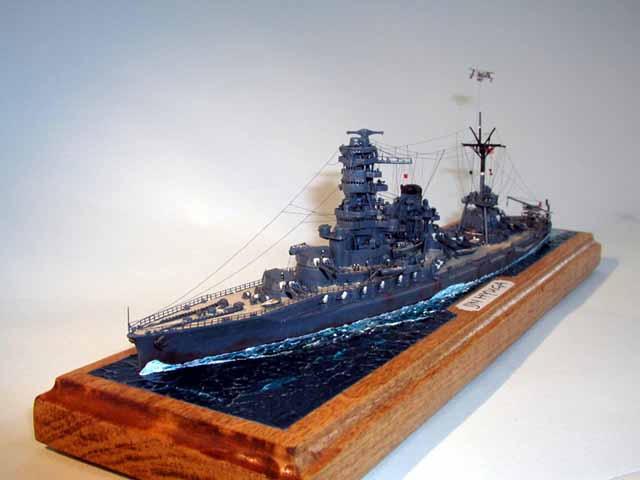
1/700 IJN Hyuga (Hasegawa)
Hasegawa Hyuga kit 118 is the basis. On this fine start I added: GMM IJN Battleship, GMM Cable Reels, WEM 1-350 Ladders & Walkways (as windows), WEM IJN Anti-Aircraft Weapons, WEM Fixed Wing Aircraft Parts, Pit Road Sailor Set, Hasegawa Ise/Hyuga Photoetch, Clipper Model IJN-36 brass barrels with bags, Waterline Series Heavy Vessel Ordnance Set for planes, boats and bits, WEM Kure Grey, IJN Linoleum, Teak and RN White and the rigging is from World Precision Instruments and is 0.075 mm Tungsten wire. My primary reference was Gakken Pacific War Series No. 26 Ise Class Battleships. This book details the changes to Hyuga’s tripod from that of sister Ise.
The Build:
This would be a great out of box build but there is so much opportunity to tinker. The kit design allows for after market photoetch to be added around the funnel. I then turned to the after block and remade the aft tripod legs from brass rod. The main mast was also scratch built to get the detail of the aerial supports correct. As per Gakken 26 the pagoda was rebuilt to that of Hyuga with the rear openings added. As the pagoda went together I added the companionways and bracing deck by deck. The foremast is integral to the structure. The pagoda legs are slipped in last as the structure is attached to the main deck. Suitably sized drill bits kept decks aligned and ensured that by spinning out the bit, brass rod legs would go back in.
Details of the sub-calibre practice guns are from photos in the Gakken 26 book and the large-scale model of Ise. I could not track photos of the sub-calibre guns actually being used. I assume a loader and ejector rating per gun. So four working ratings of course need a P.O. to oversee all. How the 1” ammunition was passed I do not know.
Thanks to Kerry Jang for the thought of using fine metal wire for rigging. The tungsten was chosen as it usually has a very slight tooth that allowed for easy colouring with a permanent marker and easy glue adhesion. Rigging does go slow as each line must be pre-shaped for the location. What surprised me was the strength in the rig once it was finished. An errant finger was not always disastrous.
Flags are my own printing via colour laser onto Avery labels, cut, folded and rigged. I tried the laser printed onto decal stock but even with fixative the images where not stable.
Water was a combination of techniques from Rusty White and Len Roberto. Rust is from www.bragdonent.com or from your local railroad shop.
Inspiration came from viewing the builds of J. Kluger, Tom Kristiansen, Byoung Dae Lee and Lars Mosbaek. I find it interesting that the private ship Hyuga is so much more commonly modelled than sister ship Ise; perhaps we do not like admirals’ flags.
I have included a picture of my original 1971 Hyuga build next to this 2006 build. In 1971 ship modeling was in isolation with limited or no resources. With the quality of current kits, after market vendor support and this forum for inspiration and advice; we do live in halcyon times for ship modellers.
