by Rainer Michalek
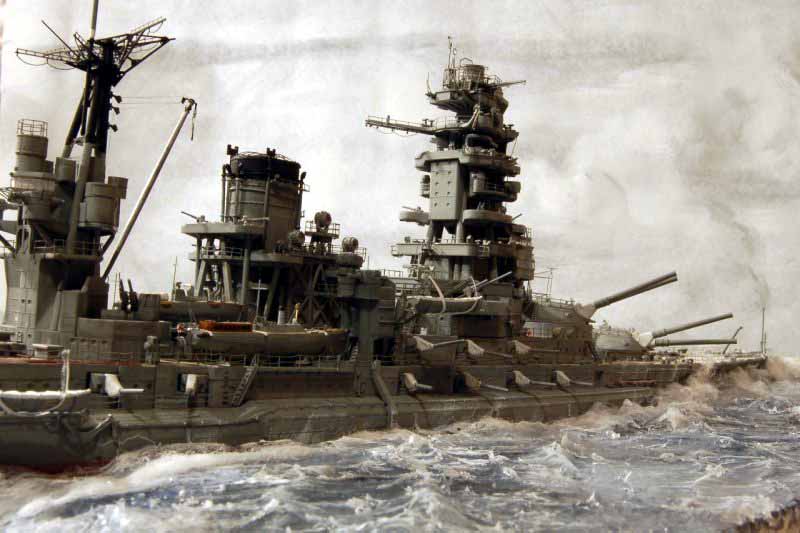
1/350 IJN Nagato (Hasegawa)
Hasegawa´s Nagato kit comprises 847 parts on 30 sprues. There is one clear sprue for the bridge and skylights. The kit includes an anchor chain, a sheet of flags and a comprehensive decal sheet. The 24-page instruction booklet describes the building process on 23 steps. The rigging and painting plan uses Gunze Sangyo / Mr Color paints as reference. As the rigging plan is incomplete, further reference should be consulted.
Had Hasegawa´s Mikasa and Yukikaze kits already been designed on the highest level, this kit surpasses them in terms of fit. The hull consists of 15 parts, 13 of which are bulkheads. I dryfit the whole assembly after removing the parts from their sprues, and was amazed. Everything fitted seamlessly! -- injection molding at its finest. The Nagato kit is designed to be built in various subassemblies, allowing simultaneous construction of different sections without handling the entire model. All deck pieces fit seamlessly without the use of putty. The fore cabin deck with turret “B” barbette includes bulkheads on its lower side. Integral to these are the bulkhead sections with the six 5” casemates of the secondary artillery. This design enables their assembly to the deck without the risk of glue being visible.
The instructions make it very clear where holes have to be drilled for the 1941 fit, to install cable reels, vents, boats and the like. All parts added in a given construction step are shaded darker and their respective colour callouts are given. Not having to handle the entire model all the time reduces the risk of leaving fingerprints in the paint job to a minimum. Prior to painting, the parts need de-greasing with detergent to improve paint adhesion. The hull above the waterline was airbrushed Revell 43 flat medium grey, the lower hull was brush-painted WEMCC US 14 Antifouling Red. All the large deck pieces were airbrushed WEMCC C 01 flat Teak.
Deck detail such as hatches, skylights, bitts and barbettes were brush-painted Revell 43 flat medium grey. On the quarterdeck with turret “C” barbette, the aircraft catapult was installed. As this deck area was covered in linoleum, it was painted WEMCC ACSM11 Soviet/Russian Brown. The wooden decks were weathered using a wash of highly thinned Tamiya XF-1 flat black. The superstructure, pagoda mast, funnel and aft fighting top are very finely engraved; parts fit is extremely good. Step by step, these subassemblies were assembled, detailed using Hasegawa´s PE and painted accordingly. Hasegawa has provided blastbags in different shapes for the primary artillery, in order to enable the modeler to display his ship individually.
All three PE sets include very extensive instructions and complement the kit instructions. No airbrush was used in these areas, as they were intended to have a weathered look. The advantage of brush-painting is that a weathered look can be achieved right from the start, if the modeler chooses to. The pagoda mast is bristling with binoculars and AA directors. Many refits of the vessel had added more and more platforms, ending up with this look. All PE parts were glued using Robbe cyanoacrylate glue. Including the excellent PE sets produced for the Nagato really pays off. The end result looks quite sharp, as injection molding technique simply reaches its limits at some point. The aft antenna array on the aft fighting top is a joy to behold, as virtually everything in the upper area is replaced by PE.
The eighteen barrels of the 14cm/50 cal secondary artillery should be replaced by BMK-Kleinserien barrels. For the 5” AA stands, the kit parts were used. They are very nicely detailed and were assembled using Revell glue after parts cleanup. They were then brush-painted Revell 43 medium grey. The PE railings from the Hasegawa sets work beautifully; etchings at each bend location make bending easier, and generally ease working with these parts. I was able to install all the railings on the main and upper deck within two days, which is a major time saver on a project like this.
One can really say that the larger boats are kits in their own rights, making them time-consuming in building and painting. The super detail set contains everything necessary to improve the boats to individual models. This starts by grinding away the molded-on boat cradles and ends with applying decals. The super detail set contains a plethora of items for the boats such as railings, prop shafts, props, rudders, oars, flagstaffs, life belts, anchors, steering wheels and windscreens. I will not address painting the boats to keep this review succinct. Boat rigging was simulated using fine wire and paper strips.
Now it is time to address Nagato´s scout planes. In her 1941 fit, she fielded three Nakajima E8N (“Dave”), later replaced by Mitsubishi´s F1M (“Pete”) and Aichi´s E13A (“Jake”). Needless to say, the PE set #40065 contains parts to improve those, too. There are struts for wings, main and auxiliary floats as well as props. The upper sides were painted as per instructions using Tamiya XF-11 IJN Green and Model Master Military Brown FS 30117. The undersides were painted WEMCC US09 5-B Thayer Blue. The engine case was painted Tamiya XF-1 Black, the cylinders Revell 90 Silver. After drying, the aircraft could be installed on the deck.
Before tackling the intricate rigging, I had to add canvas dodgers to the railings of the pagoda mast and the funnel searchlight platforms. White glue was used for these items.
Like in all my recent models, the rigging was done from black stretched sprue. After having added the bow and stern flagstaffs I thought I could start – or so I thought. None of all the references I had obtained proved to be helpful. Even the Futabasha booklet 24 “3D CG IJN Battleship NAGATO Super Detail” with its awesome CGI renderings depicted the rigging mostly as a muddle of lines. So I asked Jim Baumann for advice, who immediately mailed me a Profile Morskie book from the UK which contained large profiles.
I would like to thank Jim Baumann, Burkhardt Masch of BMK Kleineserien and Norbert and Nadja Thiel of NNT Modell und Buch for providing me on short notice with all the material needed to proceed with this project.
Rigging the Nagato is much more demanding than other vessels, as you will need to rig one side first, either port or starboard. You will then have to rig the area between pagoda mast and funnel, and then complete the rig on the other side of the ship. Otherwise the heat source will do too much inadvertent damage. Despite all caution I still had to redo some of the antennas during the process.
The figures I used for Nagato were provided by L´Arsénal. They were brush-painted using Humbrol 34 flat white (for the uniforms), Tamiya XF-1 flat black (boots), Humbrol 61 flat skin tone (faces and hands). They were glued using cyanoacrylate glue.
Now I would like to explain to you what made me design the sea base as I did. Long before I received the Nagato kit, I very thoroughly concerned myself with a video of the battleship Scharnhorst during operation Berlin. The video shows how the ship fights her way through heavy seas. I wanted to show Nagato just like that. A shelf was used for the base. On this shelf, a sheet of styrofoam was glued using white glue. After curing, the hull´s waterline section was marked using a fineliner, and then the material within the marks removed using a cutter knife. After some dryfitting I was able to sculpt the desired scene. First of all, the styrofoam was coloured using tempera. I always use black, ultramarine and white. These paints are mixed so to simulate shallows. Around the ship, white was used almost exclusively. The wake is also much lighter than the rest of the base.
I have described this at MW here. here.
Nagato was to be depicted diving into the seas, right before the breakers wash over the fore turrets. Right at this point my hands are tied as I have no idea of how to depict such a scene. I started with the bow wave. Clear silicone caulking was mixed with cotton wool, the wool easing sculpting the wave with a dental scaler. This time I also made the wash from wool, silicone and Schminke´s titanium white artist´s oil paint. Caution should be exercised in doing so, as the bow can easily be blemished in the process. It takes a little courage. After sculpting the sea from silicone, the waves were drybrushed with titanium white artist´s oil paint. Water washing down the hull was also simulated by drybrushing with the same paint.
I hope I was able to give you some support for your new project IJN Nagato by Hasegawa.
This is a high precision model kit, with hardly any flaws. For an average price of 165.00 Euros this kit offers loads of modeling fun. I reckoned it to be good value for money. Adding PE sets makes a real gem of the Nagato, even though she looks good straight from box already.
