by Vlad Petnicki
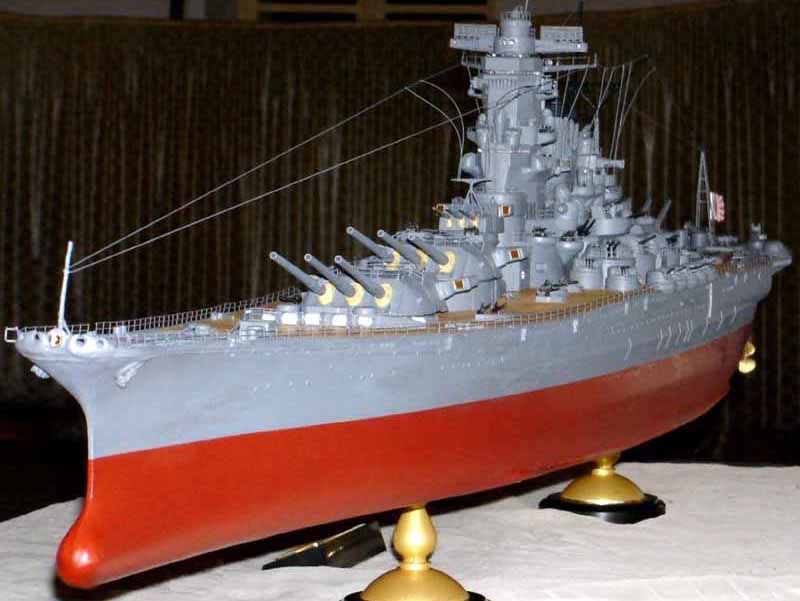
1/200 IJN Yamato (Nichimo)
It took me 5 months and hundreds of hours of work to finish this kit. More late nights and full weekends than I care to recall.
The ship was massively customized to make her correspond to the most up-to-date studies of her final April 1945 "Operation Ten-Go" configuration.
In no particular order, an itemization of the customization done:
1. All 207 plastic kit barrels were replaced with metal barrels made by GPM Models in Poland - (9-18.1 inch barrels, 6-6 inch barrels, 24-5 inch barrels, 24 batteries of triple barreled .25 cal AAA machine guns, 28 open mounts of triple barreled .25 cal AAA machine guns, 2 twin .25 cal AAA mounts and 8 single .25 cal AAA mounts;
2. The main 18.1 inch batteries were re-sculpted with Quickplastic putty to make them larger and more circular in front; Support struts were added to the sides of the 3 main battery barbettes;
3. The main forward fire director was re-sculpted into a semi-circle in the front with the aid of an exacto-knife and Quickplastic putty, in order to match the most recent research; the one supplied with the kit was rectangular;
4. All of the .25 cal AAA machine gun mounts were partially built from photoetch kits made by GPM Models in Poland (a true nightmare as, for example, each one of the 28 open .25 cal AAA 3-barrel mounts required about an hour APIECE to assemble; additionally I had to cast about a dozen new bases for the open AAA mounts as the original Nichimo kit is based on the 1944 ship configuration which lacks all of the extra AAA mounts added for Operation Ten-Go in 1945);
5. Custom hexagonal AAA buckets were built for the tops of main turrets 2 & 3;
6. Custom AAA open deck mount protection walls were built on the deck and a custom platform was built for the two stern AAA gun batteries;
7. The open aircraft well was built in the rear (the kit makes it look like an elevator, flush with the deck - the problem is, it was not an elevator but a permanent well); custom doors were built and rails added disappearing into the opening below decks from whence the aircraft were brought out); the same railroad metal rails were added to the flight deck for additional realism (though the scale of the tracks turned out to be a little too big as I figured out after I had mounted them);
8. 10 extra .25cal AAA machine gun turrets were resin-cast (note that I added custom-made metal hand rails to the front of each of the 24 AAA turrets); I also cast 4 additional AAA fire directors needed to guide all the added AAA gun mounts - two replaced the lower deck search lights and two more were added on the second deck between the 5-inch turrets; I also cast numerous additional boat divots for the sides of the ship.
9. Besides adding both of the Gold Medal Models photoetch frets items, I also made some additional photoetch details for the tops of the main and secondary turrets and some superstructure platforms from left-over GPM photoetch parts.
10. Custom made girders supporting the rear aircraft deck were added to replace the flimsy ones supplied with the kit.
BTW, the deck is not wood. Its the original Nichimo plastic deck, painted and dry-brushed with Acryllic paints.
I have undoubtedly forgotten some of the stuff I did to customize the ship, but, well, you get the general idea.
One thing that I missed was to put hatch openings, platforms and ladders to the rear of each of the 3 main 18.1" gun turrets. This will be completed next Summer when I return to the Summer house in the old country where the ship resides.
I assembled/cast the main parts of the ship in the USA but did not glue them to the deck in order to fit them in the original box for the flight to Europe.
Amazingly, despite being opened and checked out by the good folks protecting us, nothing was lost(!). Once I got it to its final destination, I glued the main parts and spent 2 weeks and over a hundred additional hours to add the metal photoetch. Which left me a grand total of one more week to work on the house, spend time with old friends and snorkel in the azure-blue Mediterranean.
Lastly, thanks are due to several gentlemen without whose help my build-up of this ship kit would not have been possible:
1. Larry Pavlov of Canada, a fellow figure modeler, whose Tamiya 1/350 Yamato build-up first got me interested in this ship;
2. Paul Bishop, whose Nichimo Yamato was the first one I actually saw 'in person' at a Spring 2007 Model Show. Paul has been gracious enough to share with me not only the many extra details he added onto his ship, but was kind enough to give me samples of his own extra AAA cast turrets which assisted me greatly in making my own. He also shared with me some of his personal research resources on the ship;
3. Chuck Miller of Shanghai, China, another serious Yamatoholic and RC-ship master who went way above and beyond the call of duty in tutoring me on the various large Yamato kits available, shared further priceless research resources with me, information on where to go in Japan to find this kit cheaply, suggesting many accessories, and who has generally been a great moral support in this endeavor;
4. Bill Waldorf, whose 'how-to' guide on building this kit (archived elsewhere on this site) gave me an early indication of what I was getting myself into. While I followed my own schedule of building the kit (meaning I jumped around as the spirit moved me), I kept in mind some of his advice and implemented more than a few of the customization suggestions that he made in his article.
5. Last but certainly not least, great thanks are due to Loren Perry of Gold Medal Models for creating not one, but 2 additional metal photoetch fret kits for the Nichimo Yamato Model.
The superdetailing of the metal railings, hatches, ladders, stairs, radars, ventilator covers, aircraft deck grilles, aircraft crane and catapults his kits provide are an absolute MUST if you wish to do this ship justice.
