by Kym Knight
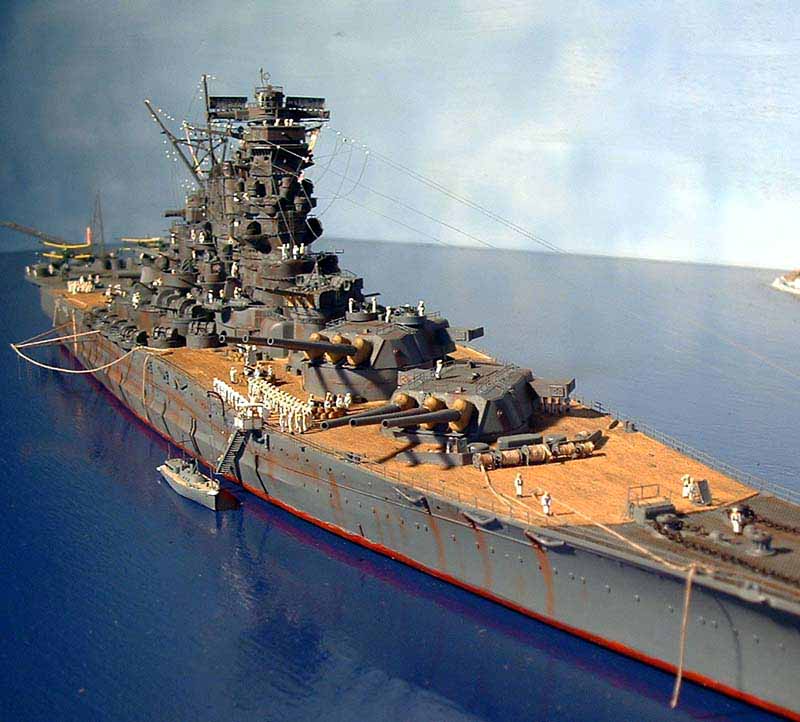
1/350 IJN Yamato (Tamiya)
Having built this kit as my second ever attempt at model building some 9 years ago, I was in no hurry to build it again. But after some statement's by fellow model club member's, that doing my dio of the ships involved in operation TEN-ICHI-GO without the Yamato, was like going to Pearl Harbor and not visiting the Arizona museum. Once I had all the parts needed, it was a pretty easy build. Waterlining and stiffening the hull has become second nature for my builds now and the only thing that caused any worries was the constant checking of reference for the known updates. There are a couple of things not quite right (probably quite a few if Chuck went over it), but I'm happy with the result.
Displacing 72,800 tons, the ship was 862 ft in length and her beam, 121 ft. Her powerful engines could propel her at 27 knots. The vessel’s massive proportions were designed to support her three main turrets which carried three 18.1-inch guns each. These enormous batteries fired armor piercing shells weighing 3,200 pounds which could range 45,000 yards – a distance of over 25 miles. She was the zenith of the man-o-war, the ultimate floating gun platform.
But by April of 1945 Yamato had contributed little to her builder’s war efforts. With its offensive capability nearly destroyed, the Japanese Navy conceived a desperate plan to utilize their greatest remaining asset to strike a desperate blow at the rising tide of American forces.
To deter the April 1st amphibious landings on Okinawa, the Japanese Army planned to launch the bulk of its remaining air fleet in kamikaze attacks on the hundreds of U.S. ships supporting the landings. In response to a query from Emperor Hirohito, the Japanese Navy drew up a plan to destroy the ships which escaped the kamikaze onslaught. Yamato would be fully loaded with ammunition, yet only given enough fuel for the voyage to Okinawa. There she would beach herself offshore and fire upon the invasion force for as long as possible. The survivors were then to join the other defenders on the island. Yamato would not be provided air cover. There was none to give.
On April 6, the “Special Surface Attack Force” consisting of Yamato, the light cruiser Yahagi, and eight destroyers, sortied from Japan’s Inland Sea under the command of Vice Admiral Seiichi Ito. However, U.S. Naval Intelligence had information regarding the run and a picket of submarines lay in wait. At 1926 hours, the submarine Threadfin picked up the task force on sonar and radar as it emerged from the Bungo Suido. Under strict orders to send a contact report prior to attacking, Threadfin dutifully notified ComSubPac headquarters. Due to Yamato’s speed, Threadfin lost her attack opportunity. However, the great ship’s fate had been sealed.
Though Yamato skirted west to avoid detection, US aircraft carriers immediately began to search for her. She was located on April 7, at mid-day by over 400 aircraft from Admiral Marc Mitscher’s Task Force 58. Helldiver dive bombers attacked immediately, releasing rockets and bombs from 1,500 feet. Hits aft started fires belowdecks that could not be extinguished. Flights of Avenger torpedo planes assaulted her next, concentrating on the port side in an effort to overwhelm the ship’s ability to counterflood. Yamato’s less heavily armored bow and stern were specifically targeted.
Despite having over 150 anti-aircraft guns aboard, Yamato could not beat back the overwhelming numbers of attacking planes. By 1415, three successive waves had struck Yamato with approximately 15 bombs and eight torpedoes. With steering and power lost, and both flooding and counterflooding causing her to settle, Admiral Ito ordered the mission canceled. At 1420, Yamato slowly capsized and began to sink but not before being rent in two by the explosion of her after magazines.
Though her remaining escorts picked up those they could before returning to Japan, of Yamato’s complement of 3,063 men only 269 survived.
