by Robert Apfelzweig
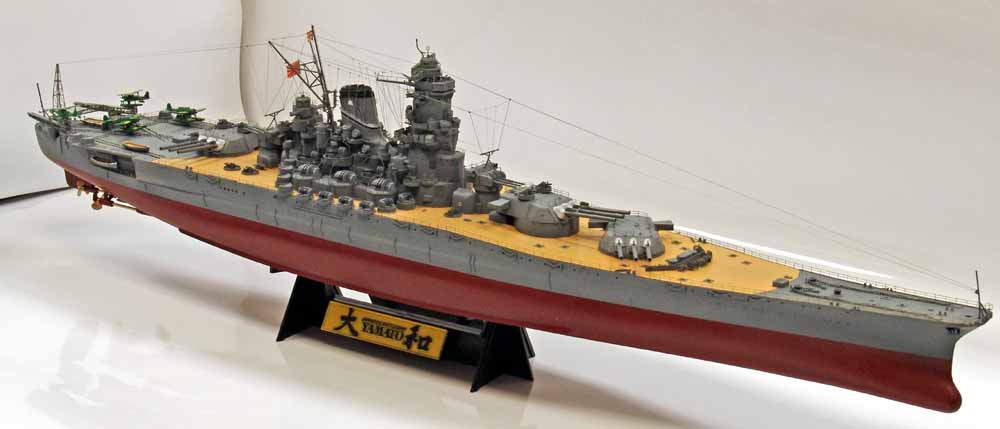
1/350 Yamato (Tamiya)
As with nearly all 1:350 ship modelers, here is my recently completed Imperial Japanese Battleship Yamato, essentially as she would have appeared during her final ill-fated sortie in April 1945. The ship is augmented with both Gold Medal Models photoetch set (standard and "extra") as well as Lionroar open-mount triple 25 mm antiaircraft guns. The latter are very finely manufactured but the brass is quite thin, making them very fragile and somewhat difficult to work with. Once assembled, these gun sets are impressive except that the barrels are essentially two-dimensional because the brass, while still double-layered, is so thin. Building an accurate Yamato (this was an older kit, now apparently out of production, which included an electric motor and mountings that I did not install) is somewhat problematic because the ship underwent significant modifications to her anti-aircraft battery between her encounters with the US Navy at the Battle off Samar in October 1944 and her final outfitting at the Kure naval base during the following two months. All but the very sternmost single 25-mm anti-aircraft guns were removed (so that, on my model, their wooden deck locations were indicated simply by the empty mounting plates, and their position holes in the gray steel or concrete deck areas were filled in with putty). There were a total of 50 triple-mounted 25-mm anti-aircraft batteries on the Yamato during her final sortie (according to Steve Wiper in his valuable Warship Pictorial #25, IJN Yamato Class Battleships publication), but the Tamiya kit only has locations for 41. There were two more elevated 25-mm gun platforms at the tip of the stern (visible in photos taken of the ship as she was under attack on April 7, 1945 -- the day she was sunk in a massive explosion as she capsized) but the kit does not include these and I did not have suitable materials to scratch-build them. The surviving photos of the Yamato under attack on this date, included in Warship Pictorial #25, are too blurred or obscured by battle smoke to make an accurate count, and determine the precise location, of the additional mounts, though I have not had access to Janusz Skulski's Anatomy of the Ship - The Battleship Yamato or any of several Japanese publications on the same subject. Wiper mentions that, ironically, one of the only 10 US Navy aircraft shot down during the Yamato's final battle was an unarmed Curtiss Helldiver fitted with both still and motion picture cameras, intended to document the battle; the crew was rescued but all the film was lost. In addition to the plastic kit parts and photoetch sets, I used narrow spare brass strips to model the fire-limiting guards, which were steel beams mounted on either side of the 5-inch anti-aircraft guns to prevent them from accidentally firing into the ship's crowded superstructure. I placed these somewhat arbitrarily, since (again) the photographic documentation of their precise location is quite limited. Anyway, the final result has been quite pleasing to me, and the Yamato was indeed a very beautiful ship. Her destruction (after a rather brief, mundane and largely uneventful career), and the terrible loss of life that ensued, was just one more tragedy in a war filled with numerous tragedies. Incidentally, a YouTube clip from a Japanese film about the ship's destruction can be seen at http://www.youtube.com/watch?v=CUl1mAjTTb0&feature=related. This illustrates quite vividly the efforts of the crew manning several of the 25-mm antiaircraft gun mounts in the Yamato's final battle.
