by John Leyland
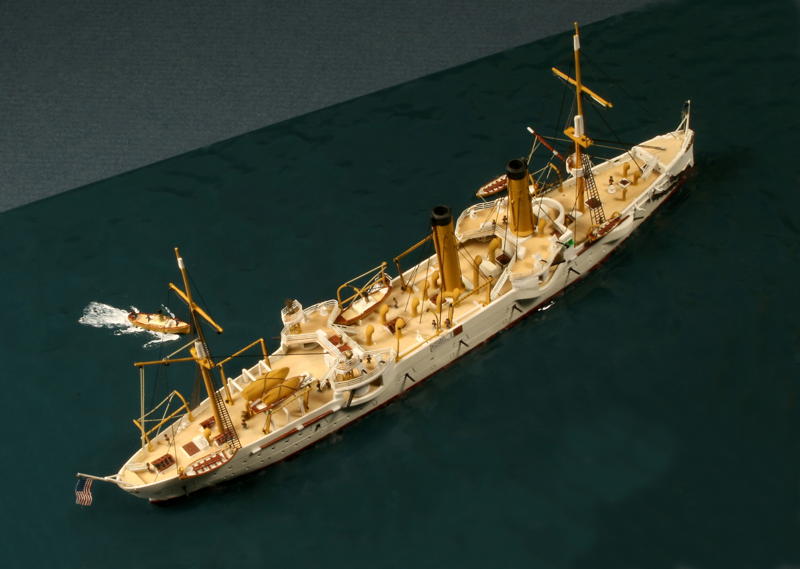
1/700 Protected Cruiser USS Chicago 1898 (Combrig)
The protected cruiser USS Chicago was one of four ships built under the 1883 naval appropriations bill. The USN had built no modern warships for many years and the designs of the cruisers Atlanta, Boston, Chicago and the dispatch boat Dolphin were intended to push the modernization and increase the capability of US yards to produce modern machinery, guns, and armor. The winning builder for all four ships, John Roach of Chester, Pennsylvania, while having the most advanced capability of the bidders to produce the needed equiptment was also a friend of the Secretary of the Navy. The matter became a political issue such that when the new Secretary of the Navy under the administration of Grover Cleveland came to office, he voided the contracts driving Roach into bankrupcy. The result of the political mismanagement was a six year period of construction for Chicago, the most ambitious of the four designs, and a guarantee of her obsolescence on commissioning in 1889. In 1895 she was decommissioned for modernization involving removal of the three masted sailing rig, regunning, and replacement of her machinery. She rejoined the fleet in December 1898, having just missed participation in the Spanish-American War. She served in various capacities including flagship of the Submarine Force 1917-1923. While she can boast no glorious victories, along with her "ABCD" sisters, her construction was part of a necessary "learning curve" in the development of the US shipbuilding industry.
The Combrig kit represents USS Chicago as she emerged from refit in 1898. The kit is done to Combrig's usual excellent standards of casting, needing little more than cleanup and painting. The kit includes no photoetch, so various Gold Medal Models sets were used, including the shroud/ratlines from the merchant set. Photos from Navsource were needed to supplement the minimal Combrig plans, including very useful contemporary colored post cards. The masts were replaced with brass tubing and some details including the boat stowage racks and davits were scratchbuilt. The anchor chain was braided from wire using the method presented in David Griffith's excellent book. The base is plexiglas with "water" done using Liquitex acrylic gel medium.
