by Rick Cotton
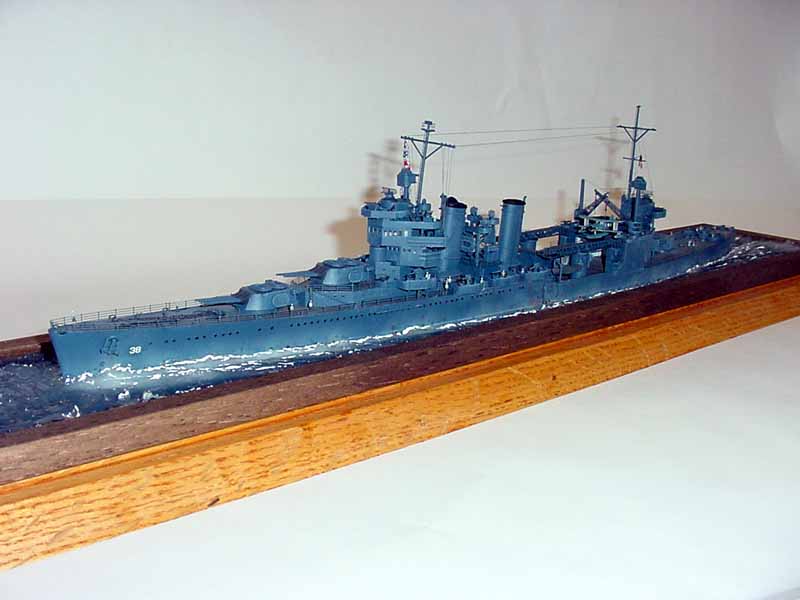
1/350 USS San Francisco CA-38 (Trumpeter)
CMDR. Egan Powell: What’s it like, Rock? A surface action?
ADM. Rockwell Torrey: About like any other battle, I guess…maybe a little noisier.
-dialogue spoken by Burgess Meredith and John Wayne, from the film “In Harm’s Way”
November 13th, 1942. The line of warships slides by, silent and blacked out in the darkness. The crews wait, tense and steeled for the coming battle. The enemy is out there, somewhere in the inky black of the waters of Iron Bottom Sound. Aboard flagship heavy cruiser San Francisco, Rear Admiral Daniel J. Callaghan scans the horizon, trying to pick out any shape in the darkness. The night is also an enemy, for the Japanese fleet is the best in the world at fighting in darkness. Callaghan knows this, his superiors know it, and they also know the Japanese are superior in numbers and firepower. But the beachhead at Guadalcanal must be protected, and the Navy will, as always, do its’ duty. Suddenly, there is a flash on the horizon…big 14” Japanese guns are firing at the San Francisco’s thin plating. Callaghan orders his ships to return fire….and the San Francisco sails on into steel, fire, death…..and immortality.
Trumpeter’s choice for its’ first 1/350th plastic “Treaty Cruiser” (indeed, the first one in this scale of ANY treaty cruiser) was a natural. San Francisco earned a huge number of battle honors, and paid dearly for them as well. Four Medals of Honor (2 posthumously), 29 Navy Crosses, 21 Silver Stars, 17 Battle Stars, and the Presidential Unit Citation are among her awards. The price paid was steep: 267 members of her crew, including Rear Admiral Callaghan, paid the ultimate sacrifice for their country.
The kit comes in Trumpeter’s traditional sturdy box, with very nice box art , and a very questionable color plan/profile inside. Trust me folks…she was Measure 21..that’s 5-N Navy Blue on all vertical surfaces, with a Norfolk Blue 21 stained deck (Pollyscale makes these exact colors …the deck stain is called Weathered Deck Blue). Pay no attention to the mysterious shaded/lighter-on-top color plan. Paint it 5-N Blue, then weather it. There are numerous photos of CA-38 at this time period, showing a heavily weathered and stained hull, obviously a ship that worked very, very hard.
There are two SOC Seagulls provided in clear plastic, but with decals for only one of them. I dipped into my spares box for the others. There are the usual US flags in decal form, and four hull number 38’s are provided. I didn’t notice if the ensigns are correct or not, because I make my own and never use the kit version. The kit parts themselves are in Trumpeter’s typical soft gray plastic, with a separate hull bottom in dark red plastic. There are no photoetch parts provided.
Detail overall is very good, with open portholes, bridge windows, and the like, above the main deck. Portholes in the hull are inset. Shape of the hull looks very good, although I don’t claim to be an expert on the New Orleans class cruisers. The deck is engraved, and the wood planking looks to be close to scale. The hangar is molded with the rolling door shut. Chains are molded into the deck, and will need to be sanded off and replaced by tiny scale anchor chain. I decided to open the hangar deck and scratchbuilt the bulkheads inside with some Evergreen scrap styrene, and used some leftover photoetch to simulate structure on the bottom side of the overhead. I have never seen a photo of the interior of this area, so, yes, it was an educated guess as to what’s in there. I would suggest deviating from the instructions a bit here….when assembling the hangar, attach the two side bulkheads to the forward (door) bulkhead first, then attach these to the hull before adding the aft bulkhead to the structure. Test fit these parts first, and you’ll see what I mean.
Fit is much like the 1/350 USS North Carolina kit by Trumpeter…not bad, but you’ll have to clean up mold marks on the back of parts, and fill seams on deckhouses (stop whining, it’s called MODELLING, not ASSEMBLING). I glassed in my bridges with thin sheet butyrate. A lot of detail could be scratchbuilt and seen in there, if the modeler wishes.
I used Tom’s Modelworks brass photoetch for the catapults, cranes, and most of the tiny details, and Gold Medal models sailors to man the ship. Fly fishing line makes up the rigging.
I found the model to be a fun, relatively easy build. Few problems presented themselves, and the ones that did were minor. The single-color scheme sounds boring, until you begin drybrushing and shading, and all that surface detail comes to life.
A sidenote: I personally have a family connection to this ship. A “black sheep” (that’s bad guy, not VMF-214 Pilot) uncle of mine, from my mother’s side of the family served on CA-38 during the last half of the war. Supposedly, he was in a 5-inch gun crew when he wasn’t in the Brig. At least, that was the story.
So there she is... CA-38, USS San Francisco... a ship that held the line when the line was thin and stretched very far. May she, and all who served in her, especially those who remain eternally on watch, be remembered for service above and beyond the call of duty.
