by David Griffith
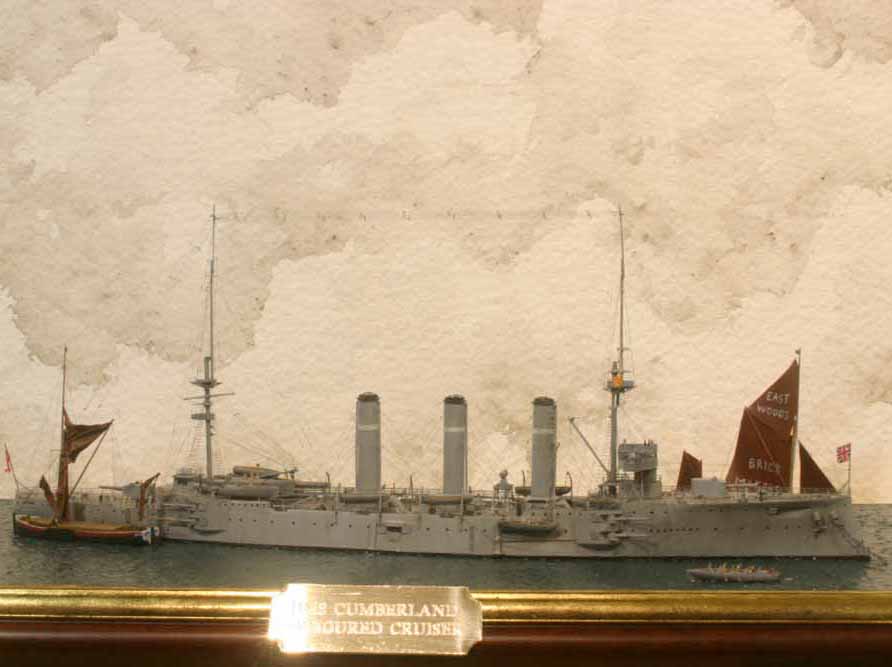
1/700 HMS Cumberland (Combrig)
This is my model of the armoured cruiser HMS Cumberland. It is from the 1/700 resin kit by Combrig. I had already built HMS Kent, but decided to make another almost identical model as I had a very clear photo of the Cumberland showing the cage aerials, and I was dying to have a go at this feature, as I regard it as the Holy Grail of small scale ship modelling.
To do these aerials, I used nylon cord teased out to individual fibres, my usual material, although this stuff from a particular cord and is even more unusually fine and requires good light to see it. I fixed two parallel pieces of this between the yards, running one on each side of vertical pieces of approx 30 thou plastic rod that I had temporarily attached to the base with Blu-Tack so that they would be separated during the rigging process. I don't know whether Blu-Tack is marketed under the same name in the USA, but it is the sticky putty stuff for fixing posters to walls. I held the ends of the fibres in place by running them down to the base and securing them with just sufficient tension in them with more lumps of Blu-Tack.
I then took rings of fine copper wire, stripped from the core of high quality speaker cable and wound around a 1.5mm diameter brass rod, and glued them to these fibres using stationer's gum (mucilage in the USA), trying to ensure that they sat on top of the two fibres, not right between them and also stayed upright.
I then took two further fibres and glued these on top of the rings, again making sure that one was on each side of the plastic rod spacers. After reassuring myself that the attachment points to the yards and the ships side were totally secure by using thin superglue, the free ends of the fibres were cut off flush and the spacer rods pulled out gently.
Other additions to the kit were some adjustment to the shape of the after boat deck and the buliding of a radio shack (I think) thereon, and a searchlight platform between the funnels, Photo-etch is by White Ensign and Gold Medal, from various frets. Other rigging material used for the thicker elements was "Caenis" fly-tying thread, a 20 denier monofilament, which was also used to do the ratlines, as I think photoetched ones look too thick.
I scratchbuilt the two spritsail barges from wood and plastic with brass rod for the masts and spars. Sails are made using cigarette paper and diluted white glue for the furled ones and kitchen foil for the ones on the barge that is underway.
The model was completed just in time for Telford a couple of weekends back, and it won the Gold Medal in the Ship Diorama class, beating Jim Baumann's Henri II into second place. It also won the YS Masterpieces Trophy for the most detailed ship model.

© ModelWarships.com