by Doug Hallet
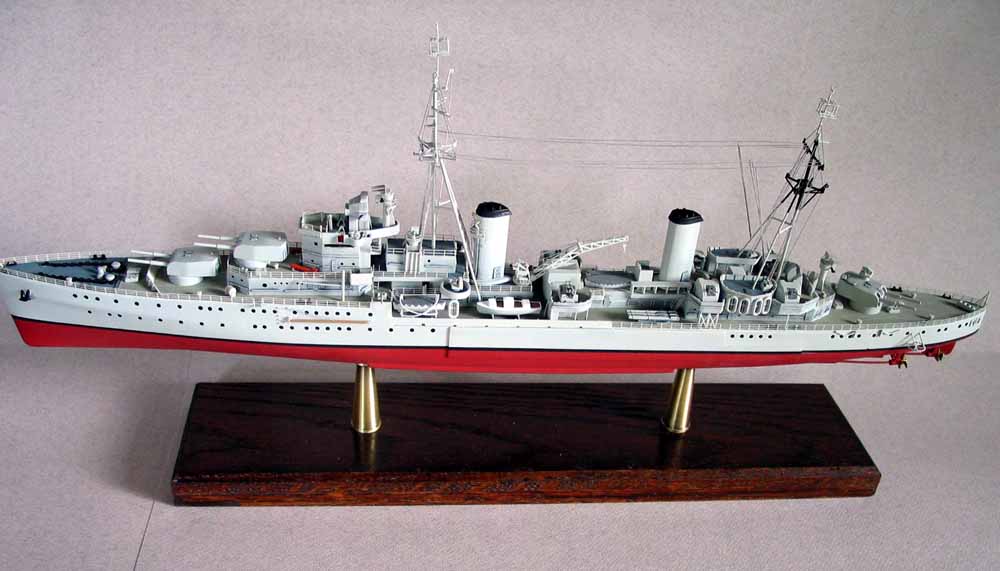
1/300 Chinese Light Cruiser Chong Qing, ex-HMS Aurora (CC Lee)
The light cruiser Chong Qing (AKA Chungking) is perhaps the most famous ship in Chinese naval history, even though it had an operational career of less than one year. Its story, however, remains almost completely unknown in the West, quickly enshrouded as it was in the beginnings of the Cold War. I was fortunate to find quite by accident a book entitled “Eighth Voyage of the Dragon, A History of China’s Quest for Sea Power”, by Bruce Swanson, USNI, 1983, which used declassified U.S. intelligence reports to fill in many of the gaps in the story, and is the only account apparently available in English. Other valuable and otherwise unobtainable information was uncovered through the marvels of Google Translator, which brought to light many articles from the Chinese and Russian web.
Chong Qing began and served most of its military career as the Royal Navy ship HMS Aurora, the last of the four Arethusa Class light cruisers designed in the mid-30s as replacements for the World War I-era A and B Class cruisers. After serving extensively in the North Atlantic and North Sea during the early part of the war, Aurora accomplished her most notable military feat, where, as a member of Force K operating out of Malta, she devastated an Italian supply convoy on its way to Rommel, sinking every ship. Badly damaged by a mine in December 1941, she spent a month in Valetta Harbor under air attack by Axis bombers before finally escaping to England. She returned to the Mediterranean in time for the Allied landings in Algeria, where she sank several Vichy destroyers in combat.
With the sea war in the Mediterranean winding down in 1944, the Chinese government approached the British about contributing vessels towards the formation of a token navy that could participate in the final defeat of Japan, in much the same manner as the British had helped create for Poland and Norway. A tentative agreement was made, and Aurora was earmarked along with seven other ships for that purpose. However, with the end of the war in the Pacific, the British Government saw no further need to subsidize the undertaking and attempted to cancel the agreement, much over the objections of the Chinese. There then began a period of intensive negotiations until an agreement was finally announced in November 1945, in which the British agreed to turn over Chunking permanently, along with a five-year lease of the destroyer HMS Mendip, in addition to a few smaller harbor vessels already in Chinese service.
Over 600 crewmen were recruited for the ship and dispatched to England for training in three groups starting in December. Among them was the 18-year old Bi-Yuan, a member of the Chinese Communist party since 1943, who had infiltrated the crew with the intent of eventually bringing ship and crew over to his side. Most of the engineering staff for the ship was recruited directly in England from among merchant seamen there at the time, with a promise that they would receive above-standard pay scales (much to the resentment of regular sailors) for joining the new ROC Navy. The collected crewmen then began a training period which went on for over two years, while the Chinese Civil War sprang back into full force, with the situation for ROC forces steadily growing worse over time. During the training period, Bi-Yuan and his later co-conspirator Wang Yi-ching were able to recruit a conspiratorial underground cell of about 10 sailors and officers from among the waiting crew.
ROCS Chong Qing, along with HMS Medip (renamed ROCS Lingfu), was finally commissioned on May 19, 1948, the Chinese having paid a total of 10 million pounds to refurbish the ship and support the crew in England while training. The crew consisted of 631 officers and men. The commander of the ship was Captain Deng Zhaoxiang, a member of the “Fuzhian clique” of professional naval officers, as opposed to the former Army officers of the “Whampoa clique”, who occupied many of the ROC Navy’s administrative posts, and who maintained a more personal loyalty to Chiang Kai-shek. Captain Deng had been in the navy since age 11, and was a graduate of the Chinese Whampoa and Fujian naval academies, and had also spent five years in England at the British Naval Academy.
The ship departed England on May 26 by way of Malta, Suez and Singapore for the trip to China, stopping at many ports on the way for public relations purposes. With the political and military situation in post-war China deteriorating rapidly, the conditions for the long-exiled crew were far from perfect. Pay was intermittent and loyalty to the ROC side became ever more questionable as the power of the PLA increased. Upon her first stop in Chinese waters at Hong Kong on July 29, 1948, somewhere above 20 members of the crew, including 1/3 of the engineering ratings, jumped ship soon after she docked. The ship continued on to the ROC capital of Nanjing with a two-shift emergency engineering arrangement, and arrived on August 14, 1948. She was visited there by Chiang Kai-shek, ROC Navy CIC Admiral Gui and many other high ranking members of the military command. Morale was further affected when the news filtered out that the ship was carrying the emergency operational reserves for the ROC navy in its hold.
Although Chong Qing was planned for deployment in the Bay of Bohai to help intercept PLA junk-based troop re-supply missions, the military situation was so serious that the ship was immediately thrown into efforts to support the retreating ROC land forces along the Shandong Peninsula and the North China coast. All through September and October, the ship provided naval gun support to the shore-based defending forces, at one point almost running aground in the process. Relationships between Captain Deng and the ROC naval command were not good, with the Captain at one point countermanding orders given without his authority by senior ROC officials on board observing the battles.
By November 1948, with the end of the successful PLA fall offensive, the ship was back in Shanghai, assigned the missions of guarding the Yangtze River crossings (now essentially the Civil War’s front line) and keeping an eye on other ROC naval units who were similarly tasked. After the fall of Mukden in November and the complete defeat of ROC forces in Northern China, the eventual victor of the conflict was now clear. Crew members began to make mental calculations for their personal odds of survivability. Additional members of the crew deserted (up to 200 by one account) and were replaced by soldiers and dock workers from the adjacent Jiangnan Shipyard.
It was in this context that Bi-Yuan and Wang Yi-ching and the other co-conspirators stepped up their efforts to approach other sympathetic crew members and implement their plot. A liberation committee was formed and an elaborate plan worked up for taking over the ship. Not unexpectedly, word of their efforts leaked out, and news reached the Chong Qing’s conspirators in return that Captain Deng would shortly be relieved of command by an officer with closer ties to the Whampoa clique. Realizing that they were in imminent danger of being arrested and shot, the conspirators met on the night of February 24, 1949 and resolved to implement their plan. They then broke into the ship’s small arms locker, armed themselves and approached Captain Deng at gunpoint, demanding that he either get the ship under way for a PLA-controlled port, or look on as they sabotaged the ship with a home-made charge consisting of fused 6-inch shells.
After considerable argument, Captain Deng finally agreed, and the ship, with a crew of 547 officers and men, cast away from its mooring at about 03:00 hours on February 25, without announcement to authorities on shore and in blacked-out conditions. The following morning, the conspirators assembled the crew and announced their full actions to considerable consternation, not so much from any residual loyalty to the ROC, but due to the fact that most crew members’ families were still on the other side of the front line. A counter-revolutionary group of about ten officers threatened to take back the ship, but bloodshed was avoided when Captain Deng, probably realizing that regardless of outcome, his career in the ROC navy was at an end, agreed to come over to the PLA side.
Chong Qing then continued north towards a PLA occupied port. The ship arrived at Yantai on the Shandong Peninsula at 6:00 AM on February 26th, flying a specially made red star flag to announce its new allegiance. Argument then resumed over an eventual course of action, with authorities in town encouraging the crew to come ashore and hand over the ship to the PLA. However, a compromise was reached to maintain the ship under the command of its existing officers and crew, and the captured ROC funds (in the form of silver coin) stored in the ship’s hold were broken into to reward all crew members with an immediate cash bonus. On February 27th, word came directly from Mao Zedong that this arrangement was acceptable to the PLA, and that local commanders should work with Captain Deng as a full ally.
Meanwhile, on March 2nd, an ROC reconnaissance plane located the Chong Qing and bombing runs by the ROC air force began, in the form high altitude bombing runs by ROC B-24 bombers. Although the initial attack was unsuccessful, the event caused renewed acrimony among the crew, with the ROC loyalists threatened to take over the ship and put her to sea if the Captain did not do so himself. The PLA faction then called on support from troops on shore to come on board and secure the ship, and a crisis was averted. However, Captain Deng did agree that a move in position would be prudent, so the ship set sail for the PLA-occupied port of Huludao in North China, arriving that evening after her one and only sortie under PLA command. Upon arrival, the ship was secured by several thousand PLA troops and all crew members were ordered to remain on board, to be reorganized and “reeducated” by political officials from the PLA. On March 15, 1949, the ship was officially incorporated into the PLA Navy, which had previously been in existence without warships.
However, after several weeks, ROC planes again located the ship and resumed their bombing runs on March 19th. With the ship out of fuel and unable to respond to these high-altitude attacks, options for survival were limited. The crew complement was reduced to about 100 men to reduce casualties in anticipation of further attacks. The first one was unsuccessful, but an attack on March 21st resulted in a bomb hit on the stern of the ship, which killed 6 men and injured 10 and caused significant damage. The rest of the crew then abandoned ship, and PLA authorities came to the conclusion that ultimately protecting her from destruction was not possible while fighting was still in progress. An order was then given to scuttle the ship for future salvage. Equipment was removed to the degree possible and machine parts given an extra coating of grease. Sea cocks were then opened and the Chong Qing was allowed to sink at the pier, eventually capsizing to starboard in 11 meters of water at a 92 degree angle, with her port hull side completely above water and showing no damage.
The loss of Chong Qing had an immediate impact on the outcome of the civil war. When the PLA spring offensive began on April 20th 1949, the remaining ROC naval forces were ordered to mount an effort to disrupt the PLA forces crossing the Yangtze. The futility of dong so was, however, was demonstrated when the British frigate HMS Amethyst was badly damaged with heavy casualties while attempting to run past the same PLA positions. Rather than make the attempt, and without the Chong Qing available to enforce the orders, the entire Shanghai flotilla of one destroyer, three destroyer escorts, one gunboat, five landing ships and eight auxiliaries defected to the PLA side on April 23rd, sealing the fate of Nanjing and Shanghai in May.
With the end of active hostilities on the Chinese mainland in 1950, efforts began to salvage and raise the vessel. A Russian technical advisory group was dispatched to assist the PLA navy engineering battalion from Qingdao, and the project got under way in April 1951. The effort was hampered by the fact that the bow of the sunken ship was only 13 meters from the pier, and efforts had to be made to attach cables and drag the ship further away before it could be righted. Once that was accomplished, hull integrity was found to be good, and the ship was raised on June 13, 1951, ahead of both schedule and budget. Chong Qing was then towed to the shipyard at Dalian on June 18, 1951, where dry dock facilities were available. However, after a thorough evaluation, the Russian technical team in charge of the effort concluded that the estimated cost to bring the admittedly obsolescent ship back into service was about 200 million rubles, an enormous cost for war-devastated China, even then in the midst of conflict with the US in Korea. Further issues involved the inability by the Russians to support the British-designed weapon and sensor systems and probably due to the fact that the ship would have been an immediate target in the continued naval skirmishes taking place with ROC forces. The PLA command reluctantly agreed, and the military career of Aurora/Chong Qing was over for good.
Parts from the hull and some machinery were removed and provided to other ships for repairs, and some weapons and equipment given to the Harbin Military Engineering Institute and the School of Dalian as teaching aids. The engines were removed and set up in a local factory. Some specialized equipment was turned over to the Russians for examination. The hull itself was towed to Shanghai in November 1959 and used for fresh water storage and renamed “Huanghe”. In 1964 it was given to the Tianjin Bohai civilian shipping firm as shore quarters for workers on coastal projects and renamed “”Beijing”. It was later completely abandoned, but the hulk survived until around 1990, when it was finally broken up in Qingdao. The metal plates containing the ship’s name in Chinese characters, which had once been attached to the hull, were later discovered at the foundry and donated to the Military Museum of the Chinese People’s Revolution in Beijing, where they are now on display.
The model
CC Lee models (from China) are very difficult to find in the West and are usually available only through specialty importers and auction sites. Intended primarily for motorization, the kit comes with a motor and drive shafts pre-installed in the hull. The basic dimensions and shapes are accurate, with a few exceptions: I moved the gun turrets to be flush with the forward edge of the barbettes, the wooden deck was extended forward of the gunwale, which itself had its support fins moved to the front side. Finally, some modifications were made to the superstructure observation deck and adjacent signal light tubs.
The kit, however, is not by any stretch of the imagination a high-quality product, and is almost entirely devoid of surface detail of any kind. Even the doors were represented by simple rectangular shapes. Virtually everything on my build was enhanced in some way to better represent Chong Qing, the problem being that all of the ships in the class were extensively modified during the course of the war and I was able to find only a few close-up pictures of her in that final 1948 configuration. Some detail was therefore extrapolated, based on similar items and locations as found on other ships of the class, plus some hints provided by my visit to HMS Belfast last summer. Modelers who intend to build this kit should bear in mind that it definitely represents the ship in its 1948 configuration. If you wish to backdate it to one of the Arethusa class cruisers while in British service, modifications to the locations of AA guns, searchlights, masts, radar, and other items will all be necessary.
The WEM WWII RN photo-etch set came in extremely useful, as it not only provided the necessary British waffle doors and square windows, but included 1/350 railings which were notably above scale compared to other companies’ product and hence did not look too notably out of place. In addition, Tom’s 1/350 inclined ladder set came in useful, along with many varieties of Evergreen, Plastruct and Lionroar rod and strips in both plastic and brass. Heavy use was also made of the parts box, with Heller ship rails once again coming in helpful as replacements for the bottoms of the large life rafts. The skirts around the funnels were scratch-built out of plastic stock and sanded into shape.
The most difficult work involved placing a new deck on top of the original horizontal surface, which badly represented the wooden planks with uneven raised lines. This required sanding down Plastruct 1 mm grooved sheeting until it was almost paper-thin, mounting it on top of the original deck, and then masking the height difference with plastic strips.
The hull color is Model Masters light grey straight out of the bottle, with the anti-fouling red being a home-made blend. The decks were painted with six shades of Tamiya deck tan, each modified with a different type of grey to give it a worn and streaked look. I also experimented with the technique of spreading oil-based paint over surface detail and then immediately wiping it off with Q-tips. This leaves the paint embedded in small surface grooves and allows much of the detail to pop out dramatically.
Much thanks to Stephen Allen of Canberra Australia for both the kit and additional advice and commentary; Kevin Dunn (Melbourne) and Roger Torgeson (Bremerton) for reference photos; and Giuseppe Giuffre (Italy) and Hanchang Kuo (California) for links to Russian and Chinese web sites. Anyone who would like to review a photo history of Chong Qing under both ROC and PLA control can see it here:
http://60.250.180.26/war/3306.html
