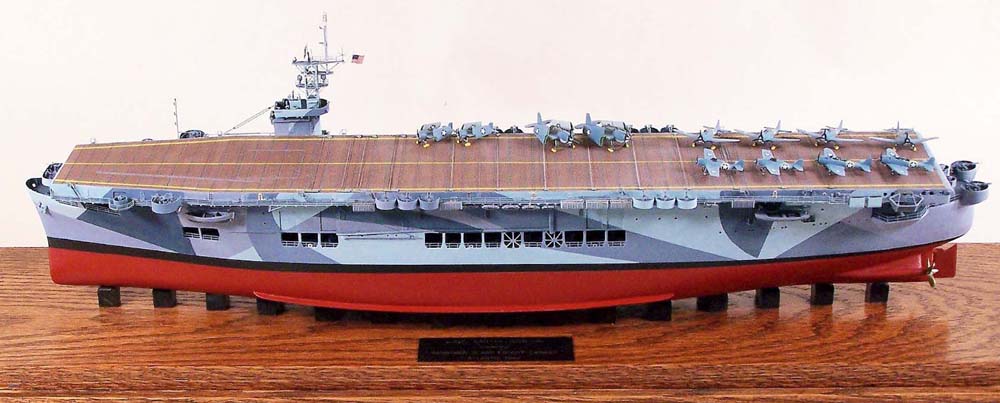
1/350 USS Santee CVE-29 (Iron Shipwrights)
|
by Richard Sliwka |
This is Iron Shipwright's USS Sangamon escort carrier kit modified to represent the USS Santee as configured in 1942. This "build" was not easy and took 350-400 hours--about 100 hours more than I had originally estimated. About 75 percent of the parts used were scratch-built, modified kit, or non-kit--many of these were due to my back-dating effort as the kit represents a 1943-44 Sangamon Class configuration. I removed the molded catwalks and replaced them with ones made from .015" plastic sheet. All 20mm, 40mm and MK-51 tubs were scratch-built. The island was modified to reflect that of the 1942 Santee with brass mast/mast details. L'Arsenal's 20mm guns, 40mm mounts, Mk-51 directors, tub ammo storage racks, floater net racks, whaleboats and SC-1 radar were used along with Paper Lab's 24" searchlights and Nuttall's 5" 51 brass barrels. Numerous flight deck/catwalk details--aft steering station, storage lockers, signal lamps, loudspeakers, vacu-formed 33' work boats. lift raft supports, antenna support structures, aircraft handling crane, forward running lights mast, etc.--were added. The 1/16" edge of the wood flight deck was covered with .010" plastic strip. Also, .080" x .125" plastic pieces were added to provide support for the flight deck and prevent sagging in the middle--these were placed at 2"-3" intervals. The model was painted in the rarely used Measure 17 camouflage scheme of navy gray, ocean gray, haze gray and light gray with a non-parallel boot-top. The camouflage pattern was determined by reviewing numerous Santee photos--BEWARE of overhang shadows. The flight deck was painted mahogany with airbrushed yellow stripes. Model Master Marine and Poly Scale acrylic paints were used. Trumpeter's F4F, SBD (with 500lb bombs) and TBF aircraft were added to the flight deck.
As I indicated, this was not an easy "build". While the kit has many good points--well detailed tanker deck, very good PE, and detailed laser cut wood flight deck for example, there are several problem areas. First, the hull sides which provide the attachment surface for the wood flight deck are too high (approx. 3/16") and not parallel to the keel--slopes forward. Second, the wood flight deck does not match the "foot print" of the flight deck support surfaces--it is 1/4" too short. Third, the island support platform is about 1/8" too far forward. These problems are compounded by a total lack of instructions--the single sheet of diagrams is very marginal at best. My advice would to obtain a good set of drawings and do a lot of dry-fitting before the actual assembly. Once one knows where the problem areas are the "build" will be much easier. If any has a question, please contact me.
