by Ken Hart
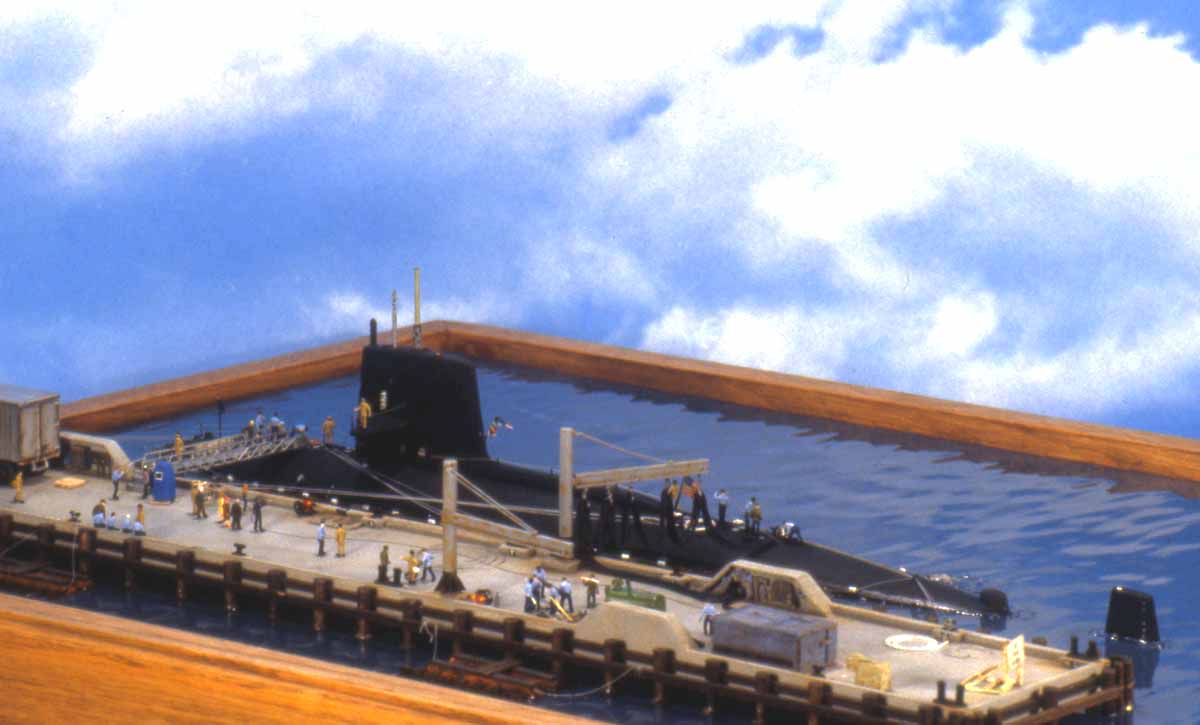
1/228 USS Skipjack SSN-585, New London, 1970's (Aurora)
A pierside diorama of USS Skipjack SSN-585 alongside, in 1/228 scale. A simple scene of one nuclear submarine moored to her pier, with lots of little details.
This diorama was donated to the U.S. Naval Submarine Force Museum just outside the sub base in New London in 1997.
It serves to show a casual day of routine activity around a pier at the lower base, and includes details such as the "drunk lines" -- a line of floats surrounding the moored ship, in case anyone should fall into the water. There is little or nothing on a sleek curved hull for someone in the water to garb hold of, so the drunk lines were devised as a routine safety protocol to a moored nuke.
Proper ship mooring lines include the fore and aft tripled ropes, as well as the all-important spring lines which criss-cross amidship. Both on the ship's deck and on the pier, excess lengths of mooring lines are always laid in a coil to help prevent trip hazards and twisting.
Shore power is established while the reactor is shut down, brought in across a boom arm with a rolling festoon of cables. Sewage lines are connected, and a telephone line is brought onboard. The ship's and the captain's pennants are flown on the aft sail staff, while the Stars & Stripes are flown astern, with the Union Jack field of stars flown at the bow.
Assorted casual maintenance keeps crewmen busy both aboard and on the pier, while visitors often come by for a look or a tour. An orange-vested sailor armed with a shotgun and a holstered .45 stands guard at the brow (gangplank). A tiny fiberglass shack provides him with shelter from the weather if needed.
As a routine security protocol, the Officer of the Deck, or one of the control room watchstanders, will take periodic scans of the area through one of the periscopes. Crew and officers come and go, things get done, and the ship sits ready and waiting for her next deployment.
As with all my diorama displays, a wood base and a 12" tall plexiglass dustcover kept everything protected during the building process, and then ever after.
A sheet of clear waterglass, available at any stained glass shop, was used. The flat underside was painted with a few coats of high-gloss enamel, leaving the thickness of the clear glass to give the illusion of depth as well as supurb reflectivity. Clear five-minute epoxy does well for ripples, as it takes on the color of the paint beneath the glass. The epoxy happens to be an excellent adhesive to secure items onto the glass surface, too.
An old Aurora no.711 SSN Skipjack kit in 1.228 scale was cut down to the ship's fitted-out waterline, with the rudder placed separately abaft. Lots of odds 'n' ends from my favorite model railroading shops, including Z-scale figures, gave me what I needed for all the detailings. The Z-scale figures are actually just a tad too big, though the tiny things were a challenge to paint. But they look "about right" without being corny.ng.
The high oblique view toward the starboard bow, using shaded lighting, made for the look of the morning's sun over the Thames River as another work day keeps the crew busy aboard USS Skipjack SSN-585 at her pier.
A starboard stern view shows the mooring lines, the shore-power cables festoon boom, and a view of the camels, which are floating bumpers, between the pier and a ship's hull, with wood ties that extend about twelve feet deep. The camels protect both the ship and the pier by rising and falling with the tides
