by Ken Hart
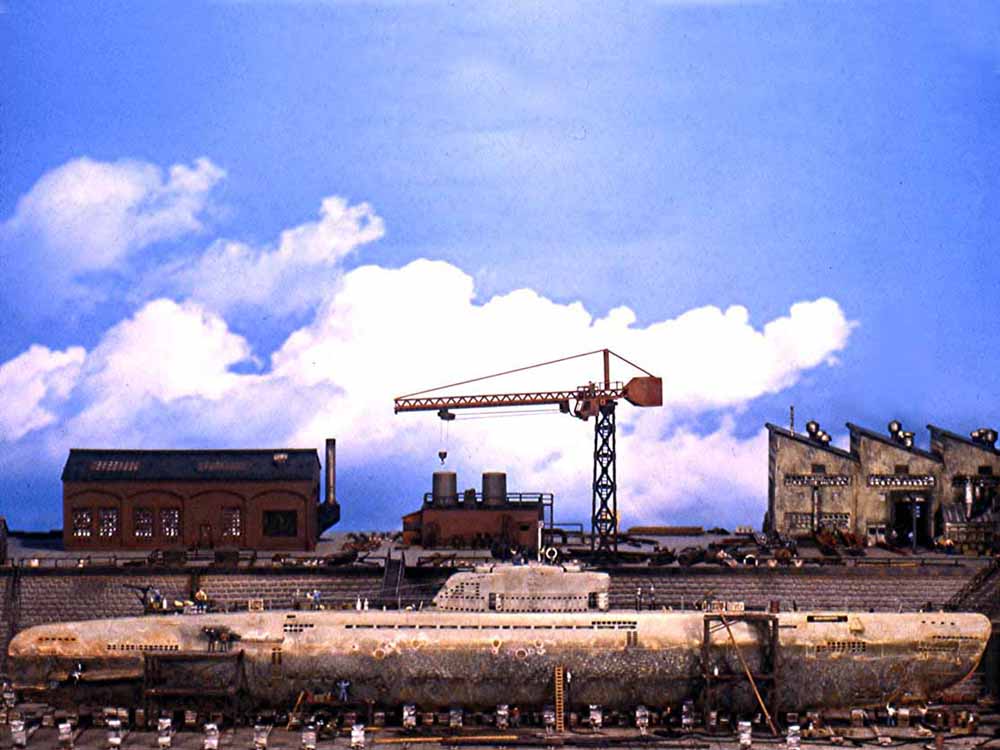
1/144 DKM Type XXI in Drydock (Revell Germany)
The challenge of a diorama scenario is really nothing more than a number of small, separate models assembled together to form one scene. It's like building a 3D photograph. Strict attention to the smallest of details is the key. Research provides knowing what details will work and what won't, while a sense of observation brings realism to the detailings. Details which may be slightly out of scale, either a little too large or too small, will still work okay if it's not something blatantly obvious.
With the Revell Germany kit no. 5081 in 1/144 scale, it was close enough to N-scale railroad size to use a lot of model railroad effects. As always, a model railroad shop is a diorama builder's treasure trove. There are all sorts of nifty items available for just about any Type modeling project. Some kit-bashing, some scratchbuilding, some common sense and determination will provide the feel to achieve nearly any sort of feel.
Having done plenty of pierside diorama scenes, I wanted to do something a little different with this U-Boat project, so I decided on a cut-away drydock scenario. That way, the model's details wouldn't be concealed from view within a totally enclosed docking basin. So, to set the scene, the first step was to build an "L" shaped riser onto a solid base board. Then it had to be fleshed out with detailing and various N-scale model railroad buildings and effects. I bought a few little building kits on sale and fudged them to suit my needs. The saw-tooth roofed machine shop was a lot of fun, and I definitely went beyond the call of duty on that one.
The machine shop's interior holds more than meets the eye, or the camera lens. I built an internal I-beam framework, and then proceeded to fit the building out with electrical conduits for switches, lighting, and distribution disconnect terminals, air ventilation ducting, and even an overhead electric crane system, all scratchbuilt. There are even floor machines and operators running them inside. I could have used LEDs to light the interior, but I didn't go that far.
The pump house building and the boom crane in front of it were scratchbuilt, while the gatehouse and the big gantry crane were tailored for the scene. The red brick field office/shop was nearly out-of-the-box, with just a few detailings added. I had to be careful not to overcrowd the layout, since the scene is supposed to be just one portion of a much larger yard spread. But I didn't want it to look too sparse, either. It had to look like a fairly busy place.
Stepped stone side walls, slider tracks for keel blocking, extra keel blocks, and all sorts of apparatus were scratchbuilt for the scene. Scaffolding, ladders, hoses, timbers, and various odds 'n' ends were made as needed. Rather than a filthy, crowded, hustling feel, I went for more of a casual working day at the drydock feel. Not too many figures, not too much debris, all in a professional, well-kept environment.
At first, I was thinking of placing a lot of sailors and military figures about, but then, though the U-Boat is a military ship, the drydock would be manned by civilian journeymen, not fighting men. The ship's captain stands on the forward deck, along with some Nazi officer from a vicinity guard troop, while another of the ship's officers is visible in the bridge cockpit. There are probably a few more sailors below decks, but most of the crew is likely off on leave in town, drinking beer and chasing skirts... The yards skilled workers have this job in hand.
With any model display, whether a stand-alone ship, or a diorama spread, good lighting makes for good photo results. Generally, a seamless backdrop is best -- nothing is more distracting than a background of the livingroom or the garage or the yard and the neighbors houses... Especially for a diorama. A seamless backdrop is simply a roll of art paper, available at any art shop. It should be long enough to more than accommodate the model from a few angles, and long enough of a roll to allow enough room that the model isn't jammed back against the backdrop, where shadows will distract. The paper roll can be slid onto a broomstick and hung from the ceiling rafters, of supported level across the backs of chairs or whatever means might be at hand. Light to medium blue, non-shiny paper workd best. Avoid bright or dominant colors like red or yellow or orange. Or white. Medium grays, blues, pastel greens, browns, any color that doesn't distract from the model. Railroad shops sell cloudy sky backdrops, desert scenes, mountainscapes, cityscapes, etc.
Camera flashes create a harsh light and deep shadows. Three separate lights are best -- one overhead and slightly forward, and one at either side slightly forward - or any combination positioned where they cast the best light for the shot. I've always used three clamp-on reflector sockets, each with a 300-watt incandescent bulb available at electric supply shops. Gotta be careful of the heat they produce, though -- they can easily disfigure plastic stretched sprue and other details on a model. Only turn the lights on long enough to get them placed properly, and then only to take a snapshot.
My photos of this diorama display were shot on tungsten-corrected 35mm slide film for publication in magazines. Out of sixty-some-odd shots, I chose thirty good ones, and only twenty or more of those. All sharp, clear, focused, and balanced. However, as I'm discovering with deep regret, it is difficult to get good slide photos transferred onto the computer. I'm sure it can be done, but I don't know how to do it, and the people helping me haven't had much success. But today is the age of digital cameras, of which I know nothing. Yet. Rather than wasting expensive film and waiting for the results, digital cameras offer immediate results, and so a photo shoot can be successful during the first set-up. The digital photos can be plugged right into the computer, and will probably not suffer from transferrence as my slide photos have. Sometime soon. this old dinosaur intends to get a decent digital camera, hopefully one with interchangeable lenses -- and then I'll have to start building models and diorama displays again so I can photograph them and share them with fellow modelers.
