by Dariusz Mazurowski
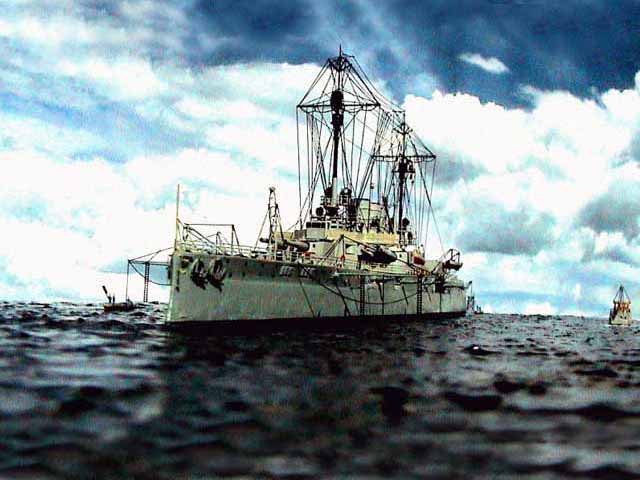
1/700 SMS Ostfriesland 1918 (HP Model)
Shortly after completion of my SMS Konig diorama I decided to carry on… and I ordered two HP Models kits (Helgoland and Westfalen). Yes, a crazy idea, but I doubt if any other kit could be worse than Konig. In fact above mentioned battleships are significantly better, but still slightly less than average. I’m not going to list all flaws, most are are pretty easy to fix BTW. Finally I’ve decided to complete the Helgoland kit as the late war SMS Ostfriesland, with some minor vessels subchasers UZ 11 and UZ 12, whale boat (Walboot, standart boat for destroyers with sails) and steam boat class A (Dampfbeiboot A). Again I've built many major parts and details from the scratch (for example : platforms, masts, supports etc.). The rest : standard PE frets (mostly GMM with Aber and Part), WSW, HP or Modelkrak boats (heavily modified), various scraps and spare parts incl. WSW set of 88 mm FLAK guns. Both subchasers are scratchbuilt items, small boats are based on modified parts from Modelkrak boat set. Water acrylic paint with varnish.
Four ships of the Helgoland class had steam triple expansion engines and same hexagonal turret layout as first German dreadnoughts the Nassau class this time with much more powerful 30,5 cm guns. All of the boilers were grouped together and those ships could be distinguished from the rest of the Hochseeflotte battle line by three funnel silhouette. According to most sources hexagonal turret layout (only 2/3 of the total number of main guns could be used for a broadside) was restricted by the use of above mentioned triple expansion engines. During construction of those ships steam turbines weren’t considered (in Imperial Germany) reliable enough for such ships. However, with the exception of engines and turret layout, Helgolands were modern and very powerful ships with very good internal subdivision, strong armor protection, quality range finders and lots of other goodies. All four ships were active during the war and took part in almost every major naval action. SMS Ostfriesland hit the mine on her way back home after Jutland (back in service in July 1916). As her sisters she wasn’t interned at Scapa Flow, but taken over by the USA in 1919 and two years later used as a target ship (bombing tests were run by General Bill Mitchell). After lots of hits Ostfriesland sank 21st of July 1921. Detailed description of those tests would be far beyond the scope of this short essay, but please keep in mind the actual state of the ship during bombing. Demolished, partly scrapped, without crew, with opened watertight doors, motionless. Mitchell wanted to prove the power of his aircraft forces so in fact it was rather a show than true test (IMHO).
SMS Ostfriesland technical data
Laid 24.12.1908 (Kaiserliche Werft, Wilhelmshaven, yard number : 31)
Launched 30.09.1909
Commissioned 1.08.1911
Displacement 22 808 t / 24 700 t (construction / full)
Dimensions 166,55 m / 167,20 m (CWL / overall) x 28,50 m x 8,68 m/ 8,84 m (construction / full)
Maximum speed 21,2 knots (on trials)
Armament (after Jutland) 12 x 305 mm /50 caliber, 14 x 150 mm / 45 caliber, 2 x 88 / 45 caliber AA, 6 x 500 mm torpedo tubes (1 bow, 4 side and 1 stern)
Armor main belt : maximum 300 mm, turrets (front) 300 mm, barbette 300 mm, conning tower 400 mm (maximum)
Overall armor weight 8 082 tons (36,8 % of total weight)
Crew 42 officers and 1 071 men (as division flagship plus 13 officers and 66 men)
UZ 11 information
Built 1916 / 1917
Displacement 43,7 / 53,1 t
Dimensions 27,20 x 4,00 x 1,47
Maximum speed 14,03 knots
UZ 12 information
Built 1916 / 1917
Displacement 43,7 / 53,2 t
Dimensions 26,00 x 4,00 x 1,47
Maximum speed 14,78 knots
