by Chris King
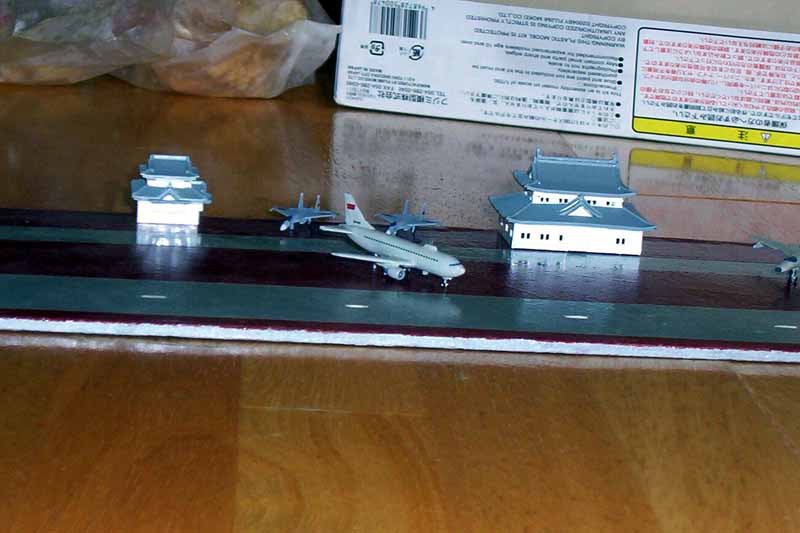
1/700 PLAAF Aircraft (Scratchbuilt)
I built the Chinese People’s Liberation Army Air Force (PLAAF) B-737 Command Post from scratch, using the wings and body parts from a Furuta miniature Boeing 777 airliner (Choco Egg) kit. The decals are custom-made, using water-slide decal paper for ink-jet printers. The Y-7 turboprop transport was also made from scratch. The H-6DU aerial refueling tanker is modified from the Pitroad TU-16 Badger metal kit. The SU-30MKK2 is also shown. It is the most advanced combat aircraft currently in service with the Chinese armed forces, with vectored-thrust nozzles and highly advanced electronics.
The SU-30MKK2 is derived from the Trumpeter SU-33 kit.
BOEING 737 AIRBORNE COMMAND POST
The PLA Fair Force (PLAAF) is currently operating nine Boeing 737 passenger jets to provide domestic and international air transportation to senior government and military officials. These planes are based at Xijiao Airfield, Beijing and flown by the 34th Air Division, the VIP transportation division of the PLAAF. At least one Boeing 737 has been modified to carry special communications equipments for airborne command and control role. The former China United Airlines (CUA), a commercial branch of the PLAAF in operation between 1986 and 2003, purchased nine Boeing 737-300 (eight B737-300 and one B737-700) passenger jet planes between 1988 and 2003 to replace its ageing VIP fleet which comprised the 1960s-era Soviet IL-18 and British Hawker Siddeley HS-121 Trident. These Boeing 737s carry the special government livery with the PRC national flag on the vertical tail, and are allocated the four-digit civil aircraft register number (B-4XXX). They operate from Xijiao Airfield in Beijing with the PLAAF 34th Air Division. At least one of the Boeing 737s (registry number B-4052) has been modified to carry special communications equipment for airborne command and control role. The plane features a large fairing containing electronic equipment (satellite communications?) located on the top of the fuselage behind the cockpit. Two more fairings are located underneath the mid-section of the fuselage, which could house secure datalink and/or ECM antennas. The aircraft also adopts a light grey air force color scheme.
H-6 TANKER
The H-6 aerial refuelling tanker aircraft, designated H-6U for the PLA Air Force (PLAAF) and H-6DU for the PLA Naval Air Force (PLANAF), was based on the Xi’an H-6 (Chinese copy of the Tu-16 Badger) twin-engine medium bomber. Fitted with a hose and drogue refuelling system, the tanker entered PLAAF and PLANAF service in the mid-1990s primarily intended to support the J-8D fighters deployed by both services. The PLA has reportedly ordered 8 Russian IL-78 Midas refuelling tankers as a supplement to its existing H-6 tanker fleet.
Y-7
The Yun-7 (Y-7) twin-engine turboprop transport plane was developed by Xi’an Aircraft Industry Company (XAC) based on the Soviet Antonov An-24 (NATO codename: Coke). Later variant Y-7H also has features of the An-26 (NATO codename: Curl). The Y-7 is currently serving with all three services of the PLA for short-range tactical airlift and training roles. XAC is upgrading the Y-7 with Western-designed avionics and powerplant. The aircraft is also available in a training variant.
Su-30MKK2
PLA Naval Air Force (PLANAF) Su-30MKK2 No.24. China ordered 24 examples of the Su-30MKK2 multirole fighter from Russia in January 2003 and received these planes in August 2004. Based on the Su-30MKK, the MKK2 variant is tailored for the PLANAF with enhanced anti-ship strike and C4ISTAR capability. These planes are currently operated by the 10th Aviation Regiment of PLANAF 4th Division based at Ningbo, Zhejiang Province.

© ModelWarships.com