by Chris King
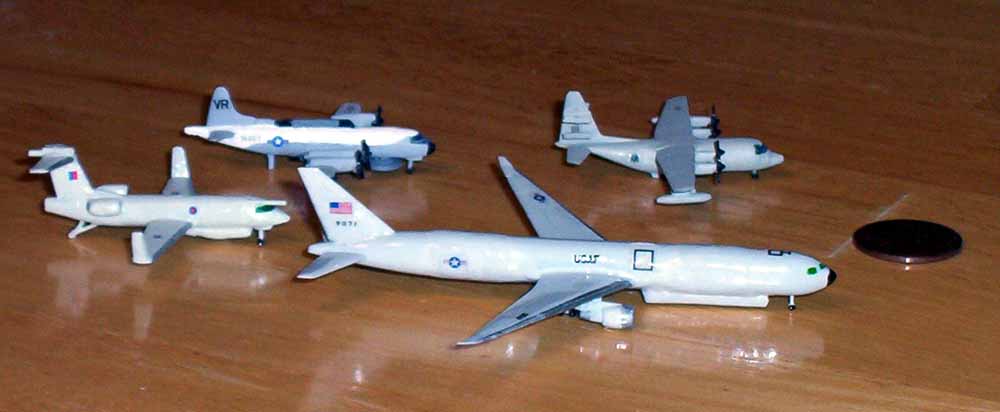
1/700 Modern SIGNIT and ELINT Aircraft (Various)
These are four Signals Intelligence and Electronic Intelligence (SIGNIT and ELINT) aircraft built from modified 1/700 Skywave/Pitroad and DML/Dragon kits.
The largest aircraft in the picture is the future USAF E-10A Multi-Sensor Command and Control Aircraft. It is intended to serve as a command-and-control hub and be able to track cruise missiles as well as ground targets. The aircraft is to be built upon a 767-ER airframe, much longer than the original 767. This required lengthening of the Pitroad 767 AWACS kit, by cutting the fuselage before and after the wings, inserting a plastic tube in both end (similar to a soda straw), and filling in the gaps with standard Testors modeling putty. Then I had to do a lot of sanding to smooth it all out.
The smallest aircraft is the new Royal Air Force ASTOR (Airborne Stand-Off Radar) system, which was made by modifying a DML/Dragon PC-3 Orion model. ASTOR is not an airborne battle management or command and control system, such as JSTARs, although operators can analyze the imagery on board the aircraft, in the ground stations and at other military sites as ASTOR passes the information in near real-time. The system will provide a 24-hour, all weather, battlefield surveillance capability. The radar range is such that the aircraft will be able to operate successfully at a safe 'Stand-off' distance behind the forward-edge-of-battle, greatly reducing the risk of loss to enemy action. ASTOR will be able to interface with the proposed military communications architecture and to be interoperable with other NATO forces. It will be a new capability for the UK Armed Forces, and the most advanced system of its kind anywhere in the world when it enters service. It will be a vital force multiplier in the modern conflict, where speed of battle is such that up-to-date information is crucial if troops are to be deployed effectively.
The C-130 variant shown is the Lockheed Martin EC-130E Rivet Rider (Commando Solo). This was built using a Pitroad "West Wings" kit. The EC-130E Commando Solo mission primarily involves psychological operations ("resistance is futile" type stuff) and civil affairs television and radio broadcasts. Under certain circumstances, broadcasts can be made over military frequencies. The aircraft normally operates alone and flies at maximum altitude to ensure that broadcasts cover the widest possible geographic area. The system can be used to support disaster relief operations, provide temporary replacement of existing transmitters or expand their areas of coverage. The aircraft has one oversized blade antenna under each wing outboard of the outermost engines. There are also two antennae projecting laterally from each side of the fin. A trailing wire antenna can also be deployed from a winch in the tail.
The Lockheed Martin EP-3E ARIES II I built using the DML/Dragon PC-3 kit. It is a land-based signals intelligence (SIGNIT) aircraft. Normally its operations are shrouded in secrecy, but one of these aircraft hit the world's headlines on 1 April 2001 when it was involved in a major incident with two fighters of the Chinese PLA-Air Force. The Navy aircraft was on a routine patrol in international airspace off Hainan Island when it was intercepted and one fighter flew too close, miscalculated its speed and in trying to slow down pitched up and hit one of the EP-3's propellers. Considerable damage was caused to both aircraft; the Chinese aircraft crashed, killing its pilot, but the EP-3 pilot managed to recover his crippled aircraft to Hainan, where he made an emergency no-flaps, three-engine landing. Once on the ground the crew found that the radome was missing, there was much debris wrapped around the tail, and one propeller was missing. After a high-level dispute, followed by negotiations, first the crew and then the aircraft were returned to the United States.

© ModelWarships.com