by John Leyland
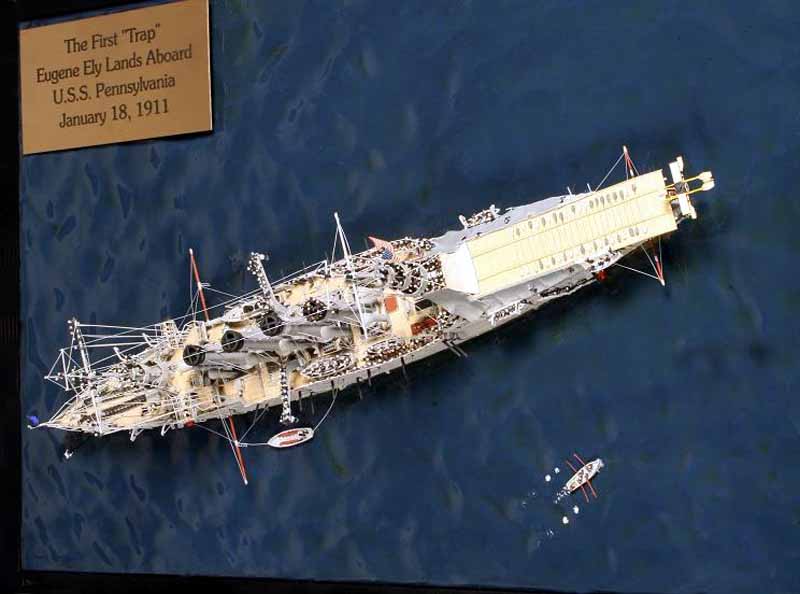
1/700 Eugene Ely Lands Aboard USS Pennsylvania (Scratchbuilt)
At 10:59 am. on January 18, 1911, Eugene Ely successfully completed the first landing of an aircraft on a ship. He devised a system of spring loaded hooks on the landing gear of his Curtis aircraft designed to snag ropes connected to 50lb. sandbags which gradually slowed the landing airplane. He called this system an "aeroplane trap", coining a term still used by carrier pilots who refer to an arrested landing as a "trap" (as in "he just logged his 100th trap"). The only consession to safety were some canvas sheets hung around the superstructure of the ship and two motorcycle inner tubes which Ely wrapped around his body as life preservers.
The armored cruiser USS Pennsylvania lay at anchor in San Francisco bay. It was intended for the ship to be underway, but the captain felt there was not enough room to maneuver, so the ship remained at anchor. While this would horrify a modern pilot, later landing experiments, especially aboard HMS Furious, suggest that swirling funnel gasses and air currents around the superstructure might actually have made the landing more difficult had the ship been underway.
The weather was windy and cloudy, but Ely flew 8 miles to the ship and landed safely on the first pass. The position of the flag in photos shows significant crosswind at the moment of landing. After an hour of preparations, Ely took off and returned to Tanforan Field at the Presidio.
The model is scratchbuilt 1/700, using the "bread and butter" method of laminated Plastruct sheets of various thicknesses in order to leave the appropriate gun casemates open. Wooden decks are Evergreen N gauge boxcar siding. The only purchased components are various GMM photoetch sheets. Two sets of plans are available from the National Archives, but one is an early builders plan with obvious differences in hull shape from the final design and the other is from the time of reconstruction when a cage mast was added, which at least is accurate for the hull. Fortunately I was able to take numerous photos of a builders model on display at the Washington DC Navy Yard museum, which has been modified with a landing deck and airplane, but without painting the model to the correct gray from the original white and buff. This model reveals the detail of the boat deck and the superstructure hidden by the canvas.
