by Charles Daigneault
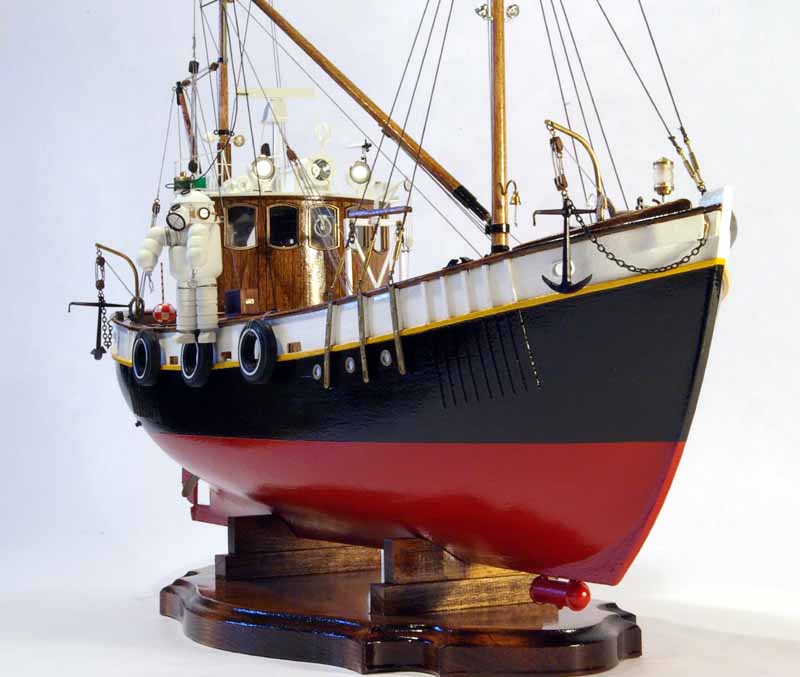
1/30 Wreck Research Vessel Harfang (Billing Boats)
I had this boat model kit you see, a 1/30 Billing boats Fiskenkutter (fishing boat) that was given to me by a friend over 30 years ago, he backed out when he saw the box contained only pieces of wood with stuff printed on it and basic a plan, no fittings, you had to purchase them separately. I have built other wooden ship models since, but the little fishing boat just lay there it’s box lost somewhere in my collection of model kits.
Last year, I got an idea while watching an episode of the sea hunters television series named from Wreck to Riches, this episode recounted the story of Mr. Reardon Beazley and his deep sea salvage company, a salvage vessel would certainly make a good model subject. Why not have another look at the Billing Boat model, maybe it would fit the task. The wood was quite dry for sure and it would be on the smallish side for this type of vessel, but I could give it a try. Over the years I had accumulated a quantity of ship fittings including Billing Boat’s, that I could put to good use, I would scratchbuild the rest.
So the idea for Wreck research vessel Harfang (white snow owl) was born, it would represent a fishing vessel that went trough a major refit becoming part of a 1960’s private venture coastal salvage fleet.
Of course this is all fiction, but as Canada and the US were going trough this era‘s social changes, up north, in 1964 to be precise, Capt. Mario Lavoie on his ship, La Canadienne was dragging chains on the sea floor of the St. Lawrence gulf between Rimouski and Pointe au Père and managed to locate the wreck of Canadian Pacific line’s ocean Liner Empress of Ireland. This fascinating story motivated me further to think about what if such a salvage firm would have existed, after all, it would certainly have been in the domain of possibilities for an ambitious and determined entrepreneur of that epoch. As in the Sea Hunters TV episode, this company would have made its living by salvaging sunken cargo of copper, brass, tin and aluminium ingots, and who knows, maybe silver or the ultimate wreck treasure, gold bullion. Well boats models are, in a way, dreams given form aren’t they?
The boat’s refit would have resulted in a redesigned and much larger wheelhouse, increased tween decks accomodations and storage, extra anchor handling gear and warping capacity, a more powerful diesel engine and 4 bladed propeller, and, state of the art for the time period of course, radar, loran (long range aid to navigation) forward looking sonar, echo sounder, ship to shore and ship to ship communications, increased deck lighting, the fishing gear to be discarded and replaced by cargo derricks and of course let’s not forget diving equipement, all this resulting in a kind of anachronic mix of features.
In this pre-gps, pre-rov’s and pre-dynamic positioning era, locating wrecks was certainly more difficult and risky than it is today. The research vessel would use sonar, drag chains ans echo sounder to find targets on the sea floor. Once such a target is located, and weather, current and tide permitting of course, the vessel would try to anchor over the site on three points. Then, in my imaginar story, a 1930’s vintage Neufeldt and Kunkhe A.D.S. (atmospheric diving suit) would be lowered in a tentative to identify and maybe photograph the target. If a promising wreck was indeed identified, it’s position would be recorded and a marker buoy moored in preparation for the deep sea salvage vesse itself to later raise the cargo using explosives and a large mechanical grapple. High-seas adventure and drama in the 60’s!
The model's hull construction is plank-on-bulkhead, the wheelhouse is mahogany planking, I have detailed the interior but not much of the work is showing trough the windows. Building materials include styrene sheet, pvc tubing, brass rod and tube. The anchors, ship’s wheel, main winch and mast lamps are Billing Boats fittings. The masts and spars were shaped by hand from square stock, derrick guimbals are turned brass stock and the rest of the fittings are scratchbuild. Deck equipement include a portable generator, air compressor, a rack of oxigen bottles for the a.d.s. a couple of old style scuba diving gear and of course the Neufeldt and Kunkhe armored suit.
Techniques used in the model’s construction vary from traditional wood and metal work to styrene and plastic and more high tech computer aided design. A feature of this model are the wheel house windows and portholes, they were modellised using Solidworks 3D software then the file was uploaded at Printapart.com who prototyped them in polymer on a 3d printer, the result was mailed back to me then the parts were sanded, painted and applied on the model. By doing this I did not have to rely on time consuming casting with it’s gooey silicone RTV and no pesky pinhole and bubbles that have to be filled.
I hope you enjoy my wreck research boat model even if it is a fictive representation, I tried to have it tell an interesting story..
