by Guido Hopp
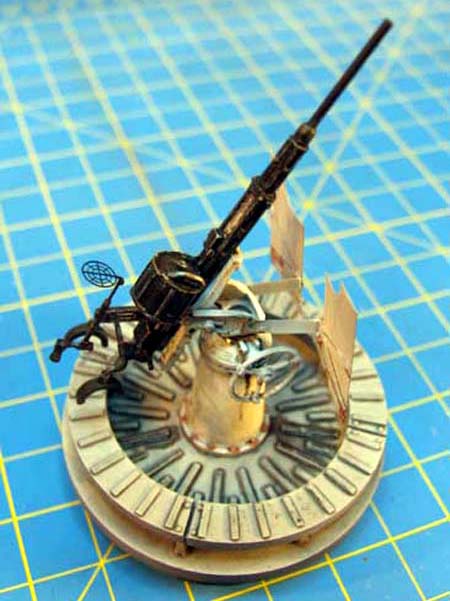
1/35 British 20mm Oerlikon, naval version (Accurate Armour)
British 20mm Oerlikon, naval version
Maker and Source: Accurate Armour, UK
Catalogue number: S-14
Product-Title: 1/35 20mm Oerlikon Naval Gun
Scale: 1/35
Price: 25,00 + 4,99 Shipping to Germany
Contents: various resin parts, 1 length of plastic tube, 1 fret of photo etched parts, 1 construction plan
The history of the 20mm Oerlikon goes way back to days when it was built in Germany known as Becker Kanone� (Becker-Canon) during WWI. Through company take-overs the design finally came to the Suisse tool maker Oerlikon and thus to world fame, fabrication and deployment. Following common procedures of the time the gun's production was licensed to various makers all over the world. In consequence in various armed conflicts one Oerlikon gun shot at another.
Most famous variants of the Suisse gun were: The French 2-cm Mitrailleuseâ€�, the Japanese Typ98, the Italian Cannone Mitragliera da 20 Oerlikonâ€�, the German 2-cm-Flak 28/29â€�, the US American 20mm-Automatic Gun Mk.Iâ€� to Mk.IVâ€� (…and indeed to Mk. XXIV) aand – of course - the British Gun, 20mm.
After WWII the weapon stood in action around the globe and even found its way to the troops of the Warsaw treaty.
The 20mm Oerlikon loading mechanism is operated through spring-reinforced gas pressure. Technical data (valid for American Mk.IV): length: 221cm (87''), weight 66,68kg (147lbs, gun only), max. elevation: -10° to +75°, muzzle velocity: Vo = 831m/s (1858.9 mph), shot ceiling: 1097m (3600'), cadence: 465-480 rounds/min , weight of warhead: 119gr (4,2 ounces).
The British version's production started as early as 1935: At the outbreak of WW II large quantities of the guns and ammo were available in stock and already in active use.
Most commonly the British used 60-round magazines, but 20-round magazines were in use, too.
Accurate Armour depicts the gun in its naval version with the widely common mkIX mounting.
(Data source: Chris Bishop: Waffen des zweiten Weltkrieges, Bechterm ISBN 3-8289-5385-9; Hans Mehl: Schiffs- und Küstenartillerie, Mittler ISBN 3-8132-0774-9)
Having been on the lookout for a suitable archetype of a 20mm Oerlikon (for the need to make my own version in 1/240), I stumbled over the multi-media kit of Accurate Armour (AA). Amongst tankies and artillery fans the company has made itself a very good name. I had seen their products many times over at the IPMS Scale Model World, Telford , UK. Despite the price tag, I did not hesitate too long to try out their product and service.
Accurate Armour's service and distribution:
Accurate Armour (AA) sells their product directly on the internet and via catalogue. All items may be shipped internationally. There's a regular choice of payment methods available. A question I asked via the contact-mail during the ordering process was answered within 6 hours. The shipment arrived 6 days after placing the order. The shipment was well protected and arrived in good condition. My credit card was correctly charged within the usual time frame.
Service and Distribution score 9 out of 10 on my board. The only set back is that one does not get an order confirmation by e-mail. (but you may check your customer account at any time) and that a shipment note is not given upon dispatch.
The kit's parts are held by a simple polybag with a printed cardboard header, which provides no transport or storage protection for the parts inside. In fact the parts of this kit are big and sturdy, but still could be damaged in such kind of packing. Those, who wish to build the kit later after arrival should seriously consider finding some kind of storage box for it.
Inside the bag the modeller will find 16 resin parts, 1 length of plastic tube and a photo etch fret featuring 7 parts. Due to the sufferable packaging one part had broken off the moulding tree upon arrival. Fortunately it was undamaged.
The resin parts mostly show some overpour. In the small parts a slight mould-alignment flaw becomes obvious. In most parts both over pour and misalignment do not pose a problem, but are a nuisance none the less.
The PE fret is flawlessly relief-etched. The brass sheet itself tends to bend a bit, but is soft enough to be rolled back using a mandrel on a hard surface.
The instructions are 4 pages in size A5 and feature some text and mostly colour printed pictures of the ready and painted product from various angles. In some cases this leads to confusion concerning the proper position of the parts, but when studied with care, it seems to turn out all fine and simple. (I still think that pictures of unpainted sub-assemblies would have been more useful – tough, less impressive of course!)
Modelling the kit is mostly straight forward. Of course a good clean-up of parts was necessary for starters, including all the usual techniques from scraping to carving to sanding. (…¦ and even if you read it for the thousandth time: Resin dust is carcinogenic! Protect yourself while working up this stuff!)
The base has a huge pouring stub that may be sawed or sanded off, or as in my case and as shown in the instructions just sanded flush. The elevated platform ring fit the base just fine after being sanded flush at the bottom. The base provides nice weight to the kit.
No big complaints here either! The positioning of the shield braces to the shield and the mount are being left to speculation, trying and colourful language. Finally, when all parts are in place you'll find there's so much tension on the braces that CA will not hold them in place for long, so you'll take the whole she-bang off and use 2-minute-epoxy. (… but maybe you have readd this article are the wiser already!) I added a couple of scale nuts to the maintenance covers on the mount (these are from a 1/35 rivet set from Verlinden). The gun cradle I fixed in an high-elevation angle. The position I chose would be natural for the un-manned gun, being distinctively back-heavy. I won't have any need to make the cradle workable, so I glued it into place. With little effort it should be possible to keep the cradle movable. The MkIX mounting was vertically adjustable to the height of the gunner and to aid the arch of the gun movement. The height of the kit's gun can be adjusted by using the small piece of tube provided with the parts. I did not use it.
As previously mentioned a mould misalignment was obvious on some parts. In the gun barrel the misalignment and some wrapping forced me to replace the barrel completely with styrene rod and tube. The triggers and handles for the gunner were too replaced by styrene rod.
…annd that was it. The assemblies were primed with Mr. Gunze 1200 and painted using my airbrush. The base was painted Deck Grey and the mount was painted with some shade of the Admiralty grey's out the British Naval Colour Coats line of WEM. "Weapon black(?)" by Gunze was used on the gun itself. The whole base, mount, and gun received black washes. For wear and tear I used Gunze „oil-stain annd „rust, as well as some ground pencil and crayonss. Finally some dry brushing with metalizing colour brought out the detail of the gun.
I chose to not glue the sub-assemblies, because transporting this kit to shows will be much easier when taken apart.
I should like to add that I did not use the gunners belt (which is supplied as a PE part). I could not make it hang� in a natural fashion.
Strength of the kit:
-Uncommon subject, nice change of pace
-Dimensionally correct, nicely detailed rendering
Weaknesses of the kit:
- mould alignment problems
- not fully satisfactory instructions
- (IMHO) insufficient packing
- Price is way too high, IMHO
