by Steve Sobieralski
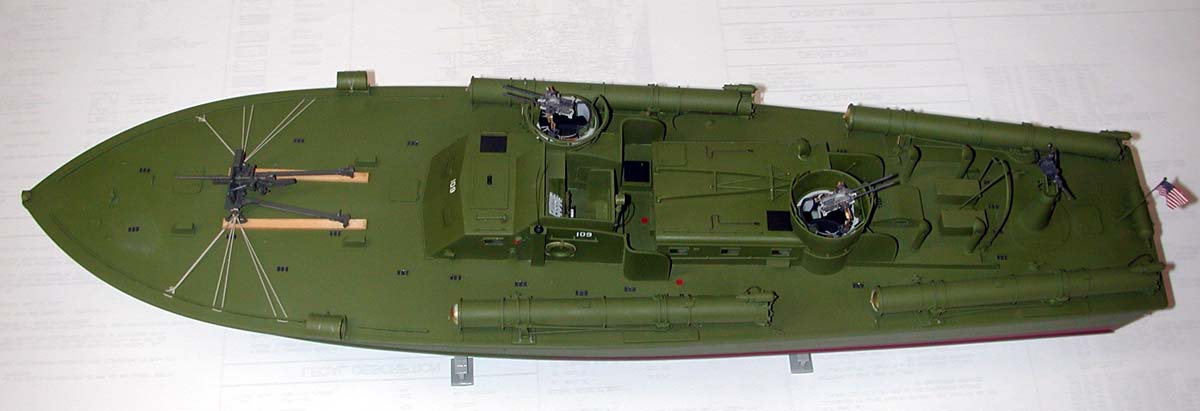
1/35 PT 109 and PT 559 (Italeri)
These are my conversions of two1/35 Italeri PT 596 kits to PT 109 and PT 559. When I bought the first kit my intention was to build it out of the box as the 596, but I really prefer the classic look of the early 80’ ELCO boats, so I decided to start the conversion to a 103-series boat. I was originally going to build a generic early boat, probably PT 117 as shown in the series of as-built photos seen in many PT reference books, but a family vacation trip to Boston included a visit to the Kennedy Library, and this kindled my interest in the 109.
I won’t list the various knowns, and the many more unknowns and maybes of PT 109’s appearance on the night she was sunk. Most of them have been discussed extensively on this and other websites. What I tried to do with this model was incorporate the knowns, use my best judgment on the maybes, and follow standard PT practice for the unknowns. One thing of which I am fairly certain is that the model is too “clean”, as PT 109 was a well-used boat when she sank, but realistic weathering is not one of my modeling skills.
As I proceeded with the build I was somewhat surprised that there were many more differences between the later and earlier boats than I had expected. Apart from the hull, propellers and shafts, rudders, and mufflers, the only parts from the kit that could be used unmodified were the smoke generator, 50 cal machine guns and mounts, and some deck fittings such as cleats and bitts. Everything else had to be either modified from the kit parts or built from scratch. One strong impression that I got from the kit was that Italeri did not design it with the idea of releasing earlier versions in mind.
Building the four torpedo tubes required the most time and effort, as each one contains over 200 individual pieces. Making the first tube was interesting and fun, but by the time the fourth one was finished the process had become somewhat tedious. I was able to speed up things somewhat by making a master of the breech plate, which has some rather complex webbed bracing, and casting four copies in resin. I also duplicated several of the kit parts in resin (the cowl vents and triangular charthouse vents for instance) because I needed more of them than the kit provided. Other major scratchbuilt parts were the foredeck vents, depth charges and racks, early type mast, new engine room companionway and 20mm cannon base, sight and shoulder brackets.
There were also extensive modifications made to the charthouse/bridge area, including relocating the 50 cal machine gun mount forward, rebuilt windshield and spray shields, and a new instrument panel. The day cabin and engine room hatch area were also reworked. A substantial amount of time was spent sanding and scraping off molded-on surface detail from these areas. I used some of the Eduard PE set for PT 596 as well as their 1/35 50 cal ammo belts for the gun turrets. Unfortunately, many of the Eduard parts are for the roll-off torpedo racks and 40 mm gun, none of which I could use. The PE deadlight frames provided with the kit could not be used either, as they were the 3-bar type, so I had to scratchbuild some 2-bar ones from plastic strips. The 37mm anti-tank gun on the bow was built from a very nice 1/35 resin kit by Trakz.
The second model is of PT 559, as she was when stationed in the Mediterranean with Ron 29 at Bastia, Corsica. What interested me about these boats was the unusual Thayer blue/deck blue color scheme, and there was also some attraction to building a Mediterranean theater boat in contrast to more usual Pacific-based PT models. The fact that I could build one using a lot more of the kit parts than had been possible for PT 109 was also a positive. I was originally going to build PT 560, one of the 40 mm equipped Ron 29 boats, and was looking forward to finally using the very nice 40mm gun that Italeri provides with the kit. I soon discovered, however, that PT 559 was the better documented boat, at least in the references I have, but the 559 was one of the four Thunderbolt equipped boats and that would require a scratchbuilt quad 20 mm mounting.
I was also intrigued by a statement in Victor Chun’s American PT Boats in World War II that the Bastia-based boats wore a 4 foot yellow stripe on the nose and a 4 foot red stripe at the stern for air recognition. I had known about the yellow painted bow, but not the red stern. As it turned out, the only photo of a boat with a discernable painted stern that I was able to find was of PT 559 leaving Bastia harbor in Frank Johnson’s United States PT Boats of World War II. There is also a close-up photo of the 559’s charthouse and bridge area in Johnson’s book which showed some interesting details. This clinched my decision to build the 559.
My next problem was finding enough information to scratchbuild a Thunderbolt mounting. Along with photos in various books, I found some drawings on Garth Connelly’s site from which I was able to get the basic shapes and sizes of the base and shield. I also found some photos online of a wartime ELCO-built model of the Thunderbolt which were very helpful. In the end, a lot of guesswork was required, but fortunately the four 20 mm cannons cover up most of the interior of the mount. I made a mold from the 20 mm gun in the kit and used that to cast four more in resin. The barrels did not cast well, but I was able to find some very nice 1/35 machined metal 20 mm barrels on eBay, so I used those. The rest of the Thunderbolt mount and sight are fabricated from Evergreen plastic sheet and shapes.
Other areas of the kit which were modified included the bridge and charthouse area. Again, a lot of surface detail on the kit parts had to be removed or modified, especially the raft brackets and the decklight on top of the charthouse. The bridge had to be converted back to the earlier style with the throttles on the port side of the wheel and the older style instrument panel, but fortunately the 50 cal gun mount did not need to be moved. The adjustable airfoil wind deflector in front of the bridge had to be scratchbuilt. I had never noticed this feature before, and was surprised to learn that they had been fitted to so many mid-series boats. I also had to scratchbuild old-style running lights for the charthouse, as well as a roof top binnacle and some other details. The “kill” markings and front port light covers are as shown in the Johnson book.
The radar mast was modified from the kit mast with some antennas and wiring added and a radome turned from a wood dowel. The engine room ventilator/hatch was narrowed to match the width of the mid-series boats and a heater box was scratchbuilt and added. Ron 29 boats also carried the squadron insignia on the bridge spray shields, which I was able to scan from a book and then print as decals. At the bow I utilized the raft from the kit, although it has square ends rather than round ends and is not really correct, and also made some small modifications to the forward 20 mm gun. I was not able to tell exactly where the anchor was mounted on the 559, but in photos of other Ron 29 boats it appeared to be stowed approximately as I have shown it.
