by Michael Maynard
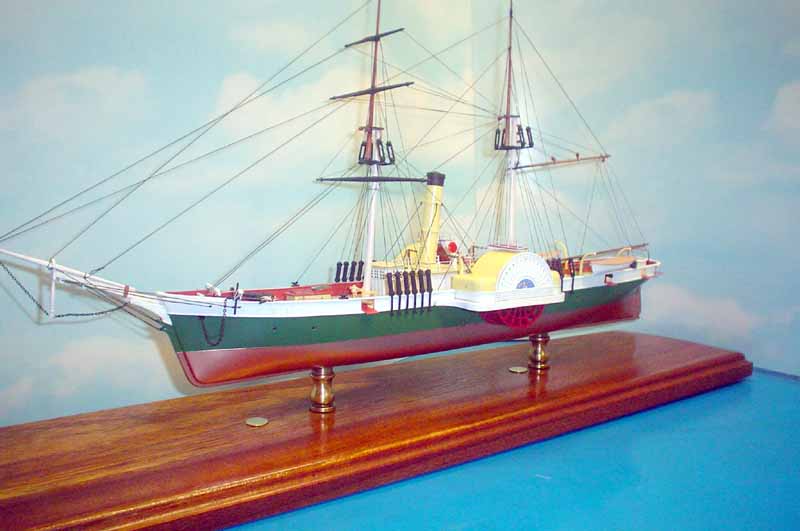
1/96 USRC Harriet Lane (Lindberg)
The Ship
The Revenue Cutter Service (predecessor of the US Coast Guard) launched the Harriet Lane in New York on June 5 1857 as a revenue cutter of the US Treasury. Named for US President James Buchanan’s niece, the 270’ long steam vessel was considered a state of the art vessel for it’s time. With a top speed of 12 knots the 750 ton cutter was out fitted with twin paddle wheels and its hull was sheathed with a copper plating below the water line. It’s early armament was considered “light” with three -32 pounders and four- 24 pounders. In 1858 the cutter was made part of a US naval squadron that sailed to Paraguay to pressure the country’s dictator to apologize for an un provoked attack on the American vessel Water Witch in 1854. According to Navy Flag officer William Shubrick the presence of the naval squadron and in particular, the steam cutter Harriet Lane, had the “desired diplomatic effect” that 4 years of negotiations couldn’t accomplish.
In 1860 the cutter embarked Edward Albert, Prince of Wales, for passage to visit Mount Vernon, to honor the memory of President Washington. Prince Albert was the first Royalty to visit America and the first to travel aboard a US warship.
Re-armed with one -4” parrot gun, one- 9” Dahlgren, two -8” Columbians and two- 24 pound brass howitzers, the “Lane” was sent to Charleston, S.C. in March 1861. It’s mission was to supply the army garrison at Fort Sumter after the outbreak of the Civil War. When the steamer Nashville approached the port with out displaying a flag, the Harriet Lane fired the first naval shot of the war. The Nashville immediately identified itself by hoisting the stars and stripes!
The cutter took part in several naval operations early in the War including the capture of Forts Clark and Hatteras and the naval operation to take New Orleans. Admiral Farragut chose the cutter as his flagship in southern waters until moving his flag to the USS Hartford in 1862. During the taking of Galveston Texas, the cutter was the flagship of the landing force and part of the blockading squadron. But on January 1, 1863 Rebel forces, in a surprise attack, retook the city and in conjunction with a Confederate naval assault the anchored Harriet Lane was captured in a night attack. The battle lasted all through the early morning and after sinking a rebel ship, the “Lane” was shelled by shore batteries and rammed by a Confederate gun boat. It was noted that the cutter’s Captain Wainwright was killed in the hand to hand fighting on deck and the cutters youngest crew member, the 10 year old son of Captain Wainwright, fired two colt revolvers at the invaders until every round was expended.
The Confederates repaired the damaged cutter, stripped it of it’s guns and converted it to a blockade runner. With a load of cotton, the former cutter made a run for Cuba but an alert Union ship re captured the vessel in Havana. It was returned to the US but after inspection is was considered “un-fit for naval service” and sold. The once proud cutter had it’s steam plant removed, and converted to a three-masted merchant schooner, renamed Elliot Ritchie. In 1881 while carrying a cargo of coal the former Harriet Lane caught fire and was abandoned off the American coast.
The Model
The Harriet Lane was offered by the Pyro Model company in 1956 and was considered to be an excellent ship model in terms of accuracy and ease of build. As released it had a black hull with a gold painted bottom. In addition the other parts were molded in buff and white, to aid in the appearance of the model should painting the parts be an issue for the builder. The Lindberg model company obtained the molds and offered the kit in 1988 as the “Blockade Runner”. Like all things Lindberg, the kit wasn’t upgraded and sold under the wrong title. Had the folks at Lindberg done a little research(like reading the assembly instructions of the 1956 kit) they would have noted that the model would have to be modified if sold as a Blockade Runner but “what’s in a name?”
While the kit makes a nice build out of the box I wanted mine to be a little more accurate or at least different. The first thing I did was fashion a deck out of wood and paint the hull green with a copper bottom. Doing a little research I found an article concerning the ships paint scheme. Apparently the Confederates found copious amounts of green paint in the ship’s bosun’s locker. I opened up the gun ports and added swivel guns in addition to the brass howitzers(brass rod filed down). I replaced the plastic spars and booms with wood dowel and added photo etch railings. I’m not much for rigging sailing ships so I followed the simple rigging directions. And if I was a little more ambitious I would have made ratlines, although I’m surprised Pyro didn’t include them in the original kit.
In conclusion, the cutter Harriet Lane still makes up a good looking model, even though the kit is 55 years old. For all you sailing ship fans out there, this is a project that, with a little extra work, could translate into a pleasant build experience for you and a nice display piece for your collection.
