by Germà Coenders
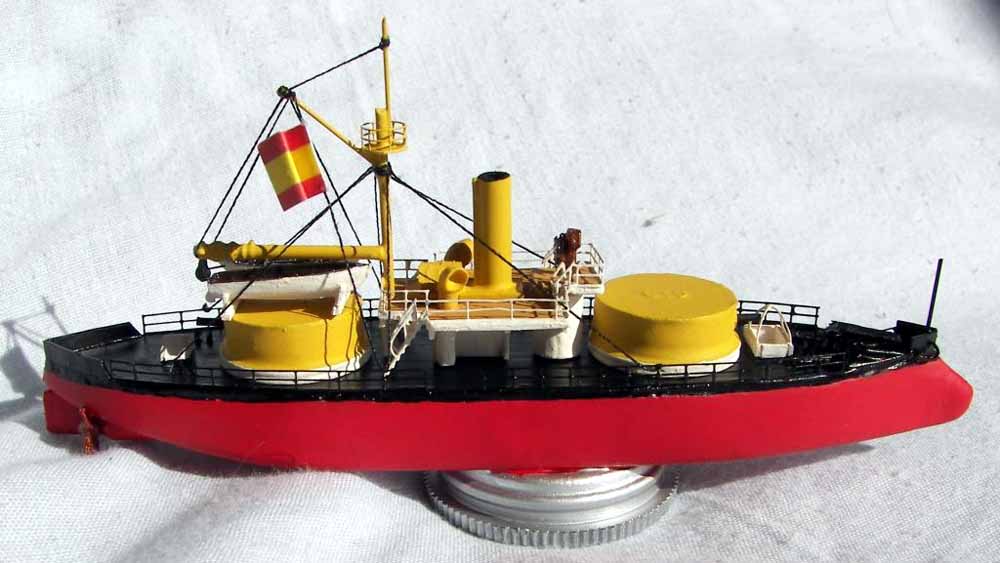
1/350 Puigcerdà, Spanish river monitor (Scratchbuilt)
During the so-called third Carlist war (1872-1876) against rebels who wanted to change the chair of the Spanish Monarchy, the Spanish Navy ordered eleven armored ships for river operations supporting the loyal army. 10 of them were 86-ton gunboats, but the eleventh was the somewhat larger Puigcerdà. Her name comes from a little town at the heart of the Pyrenees, close to Girona, which bravely resisted the siege of the Carlist general Savalls. During the War, the City of Bilbo (North of Spain) was blockaded by the Carlist troops. To support the garrison of Bilbo, the Puigcerdà was sent to the Nervión River, which passes through Bilbo.
She was like a small monitor, with two armored turrets armed with one 16 cm. and two 12 cm muzzle loaders. After the Cralist war ended there was little need for river warships and she was decommissioned. During the 1898 war Puigcerdà was recommissioned. Her bridgework was reduced and she was rearmed with two 12 cm. breech loaders. The model depicts her after these reforms. She then supported the torpedo boat units in the western Spanish continental coast, at Vigo to prevent an American attack which never came, and was decommissioned again after the war’s end.
Vital statistics:
The model was scratch built. The hull was sculpted from balsa wood. Deck and superstructures were made from pasticard. Turret bases were one and two-cent euro coins, the turrets themselves were from paper, and the rest from the spares box.
The main sources were drawings and photos in:
