by David Walsh
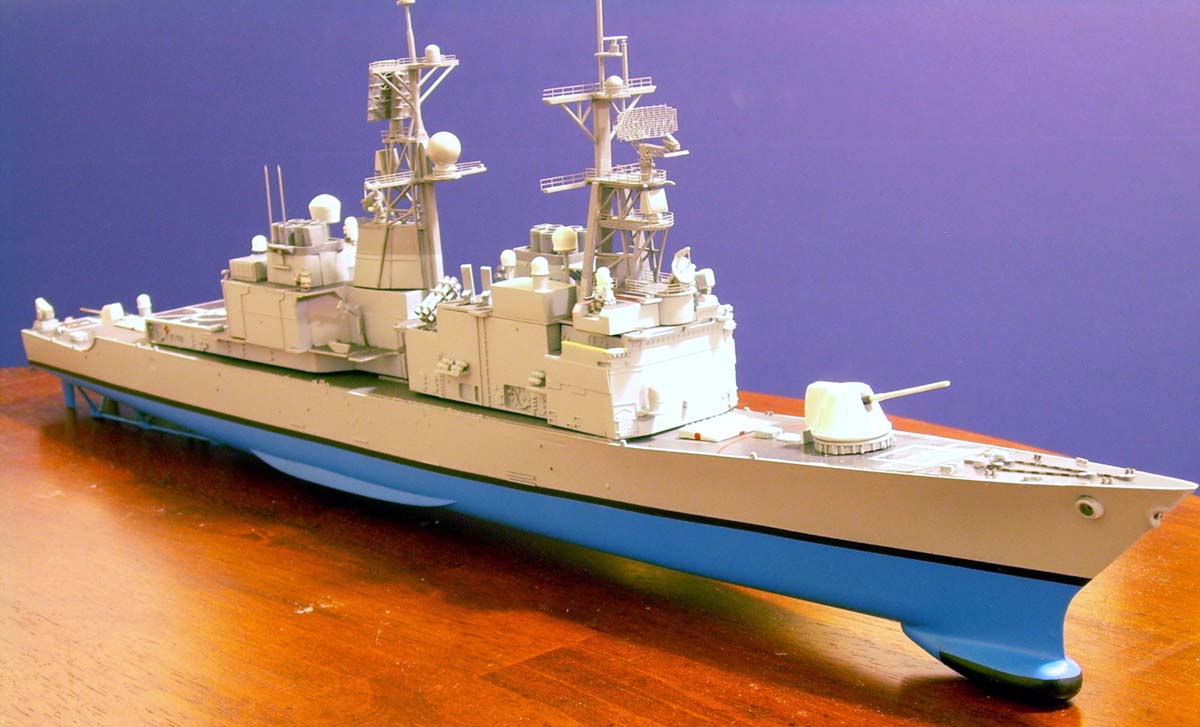
1/350 "What If" USS Spruance DDG-963 (Dragon Kitbash)
I have been fascinated with the design revolution that occurred with the Spruance-class destroyers. The Spruances were devised in an atmosphere where the Navy knew it needed a certain type of ships at the moment (ASW) and it was going to need another type in 10-15 years time (AAW) but did not have the funding to build massive numbers of both types. A specific hull was designed that could accommodate both mission types with just different equipment configurations. These were called DX and DXG. Being fitted with the latest sonar equipment and anti-submarine weaponry, the DX addressed the ASW threat, and alternatively fitted with the latest radar equipment and weaponry, DXG would address the AAW threat. This would reduce procurement costs and speed the rate at which mission-essential ships could enter the fleet. While it was planning on building the two versions simultaneously the US Navy was facing more budget choices and decided to start off by building just the ASW version then back-fitting the Tartar-D weapon direction system (WDS) onto a large number of the class to address a suspected need for AAW ships down the road. This would have included Mk26 twin-armed launchers replacing the ASROC launcher forward and Sea Sparrow launcher aft, replacement of the ship’s SPS-40 radar with the SPS-48, and the addition of one or two SPG-51 terminal illuminators. When compared to building a new ship, this modification from DD to DDG would have cheaply and quickly shifted the mission capabilities of the Navy to answer the rapidly fluctuating threats of the Soviet Navy.
With the looming decommissioning of the USS Newport News, the last 8” gun cruiser, the Navy and Marine Corps recognized that the Navy’s last credible and effective naval gunfire support capability would be lost. The Navy would be reduced to five-inch guns, a secondary battery weapon, for providing naval gunfire support (NGFS) and preparing a beach for amphibious landing. Having just come out of a war requiring the point destruction and long range capability of 8” and 16” guns, the clear and present need for gunnery greater than the 5” was recognized. The powerful 8”/55 caliber gun was to be fitted into a mount that could be taken to sea on the smaller ships the Navy was procuring. The result was the Mk71 Major Caliber Light Weight Gun. It was developed by FMC (now United Defense) and tested at sea on the USS Hull. After being proven at the Dahlgren proving ground and at sea aboard the Hull it was certified for use aboard US Navy warships. It brought the heavy 260lb HE rounds of the heavy cruisers and laser guided projectiles that would provide one-shot-one-kill capability for a major caliber gun. While at the time disinformation was provided by critics of new naval weapons claiming the Mk71 was inaccurate, the Mk71 performed very well with all types of ammunition, including the Mk25 ballistic HE round, was significantly more accurate than 5” gun, and would provide the US Navy with a precision gunnery piece for the foreseeable future. With a working range of 22nm the 60caliber barrel was fitted with a 11 caliber long chamber to accommodate extended range rounds that were already being developed. The US Navy selected it to be installed aboard all 31 of the Spruance-class DDs, strike cruiser (CSGN), and to be back-fitted aboard the USS Long Beach. The added weight and recoil of the 8” gun was included in the Spruance-class design, and all 31 members of the Spruance-class were ready for its installation.
Then in 1980 one of the Carter Administration’s last acts in conjunction with Senator Proxmire, terminated funding for the gun mount and took from the Navy a gun that could effectively be used in anti-ship warfare. What was worse was that it took from the US Marine Corps the last best hope for long-term effective and credible NGFS. With the exception of the brief 10 year return of the Iowa-class battleships from 1982-1992, the US Navy and all forces it is tasked to support with NGFS would be limited to the ineffective fire of the 5” gun for the next 35-40 years. The prototype Mk71 sat quiet at the Dahlgren proving ground out of the fight.
At the end of the Cold War and the dismantling of the 600-ship fleet under the Clinton Administration, the US Navy’s budget was drastically cut. In order to reduce the fuel costs required to complete deployments, the US Navy began leaving ships overseas at various bases and would swap out the crew. This was the beginning of a program called “Sea Swap” where the would replace the ships’ crews instead of completing a ship’s deployment. In theory this sounded attractive, however as time went on and crews swapped from different ship to different ship, the crews lost any sense of ownership in the vessels, and maintenance fell to historic lows. Because the ships were constantly overseas they did not receive necessary yard periods. Within 10 years the majority of the Spruance-class class suffered significant problems from extreme lack of maintenance and corrosion. Because the US Navy tried to save money it ruined an entire class of capable modern warship. The Navy gambled with the Sea Swap program, and it lost.
In order to repair the ships and allow them to be used for their intended service lives they needed a significant repair period referred to as a hull maintenance and engineering (HM&E) upgrade. This would have enabled the ships even beyond their 30 year life spans. However, in order to shift funding to the DDX (now DDG-1000) and littoral combat ship (LCS) programs, the repairs and modernizations were canceled, and the Navy systematically decommissioned capable, modern warships well before the ends of their service lives. The whole Spruance-class was decommissioned. Instead of preserving the ships as mothball assets ready to be reactivated if the time came, the Navy instead decided to scrap and destroy all but one. Now, the Navy could never correct its mistake.
In 2010 the US Navy stated that it needed a 313 ship fleet to accomplish its stated missions, but after destroying the Spruance-class it found itself 26 ships short with only 287 ships. The US Navy’s budget does not allow for it to build the 26 ships needed to correct this short fall. However, with the cost of a single new destroyer the Navy could have reactivated and modernized 20 Spruance-class destroyers and corrected this mission critical, and some have testified “negligent”, shortfall.
As a “What If” project I took on the question of what if the Navy reactivated and modernized the Spruance-class destroyers instead of destroying them all? With the tremendous help from modelwarships community and the input from Naval Sea Systems Command (NAVSEA) in Portsmouth, Virginia, I was able to develop a modernized version of the Spruance-class that took advantage of the class’s mission conversion features that answered the mission critical needs of the US Navy with minimal cost. This model reflected the need for more AAW ships without the prohibitive costs of the Aegis WDS, the need to provide credible NGFS, and the need for more capable ships.
The modernization took advantage of at least the 7 Spruance-class DDs that did not have their ASROC launchers replaced with 61-cell VLS. The modifications included:
In appearance, this ship looks like a modified Kidd-class DDG. From modified masts to the Phalanx Block 1B, RAM, and comms domes there was a lot of scratch building involved in this model. Being based at Norfolk Naval Shipyard I had the opportunity to watch US Navy ships being repaired and upgraded on a daily basis. A number of the CGs were getting a new light blue anti-fouling paint applied to their undersides. I chose that color for the Spruance-DDG. I added the stern wedge the CGs were getting as well. I also added the NULKA cruise missile decoys. Those are pretty important these days!
As you can tell the model was not finished at the time these pictures were taken. I was changing duty station, and I shipped it back home before taking a final photo shoot of it. Unfortunately the US Post Office did a real number on the model, smashed and crashed it.
Later this year I intend to give it a second shot and produce it again. There is an on-going thread on the forum and offers a lot of the technical information and deduction of how I got to the final product.
Thanks for looking! I hope you like it!
