by Chris King
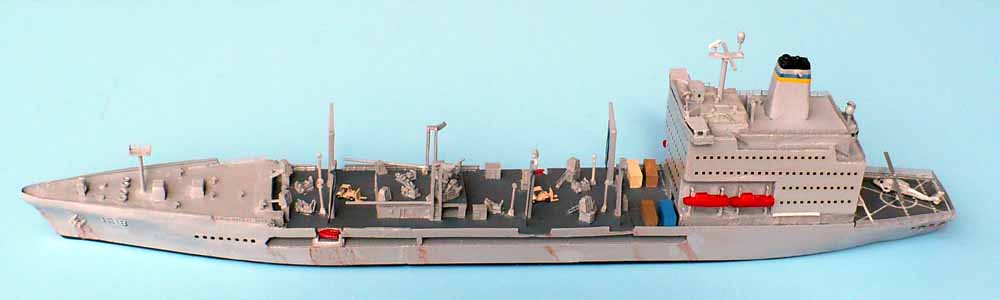
1/700 USNS Big Horn T-AO-198 (JAG Kitbash)
I wanted to build a large US fleet replenishment ship that is currently in service. Unfortunately it was not until after I had built the JAG Cimmarron kit that I realized the ships of the class had been put in reserve some years back. I still wanted to have a "modern" oiler, so after searching on the internet it looked like the easiest thing to do would be to modify a Cimmarron kit into one of the Henry J. Kaiser class ships. At first glance they appear very similar to the Cimmarron class, but when you get down to printing out plans and pictures the differences are numerous. I had to cut the hull in two, rearrange the main deck, and scratch-build a main superstructure and funnel. Custom-made window decals helped give it a more realistic look. If I didn't have the JAG kit as a basis to work off of I don't think I could have pulled this off. This was one of the most challenging projects I've attempted.
The Henry J. Kaiser class is a class of fleet replenishment oilers which began construction in August 1984. The class comprises eighteen underway replenishment oilers which are operated by Military Sealift Command to provide underway replenishment of fuel to United States Navy combat ships and jet fuel for aircraft aboard aircraft carriers at sea. The first ship, Henry J. Kaiser, was laid down on 22 August 1984, and construction continued until delivery of the final unit, Laramie, on 7 May 1996. There are stations on both sides of each ship for underway replenishment of fuel and stores. The ships in this class have a small capacity to carry and transfer fresh and frozen foods as well as other materials, and have two dry cargo transfer rigs. Patuxent, Laramie, and Rappahannok differ from the other 15 ships in having double hulls to meet the requirements of the Oil Pollution Act of 1990. Hull separation is 6 feet (1.83 m) at the sides and 6 feet 6 inches (1.98 m) on the bottom.

© ModelWarships.com