by Monty Fowler
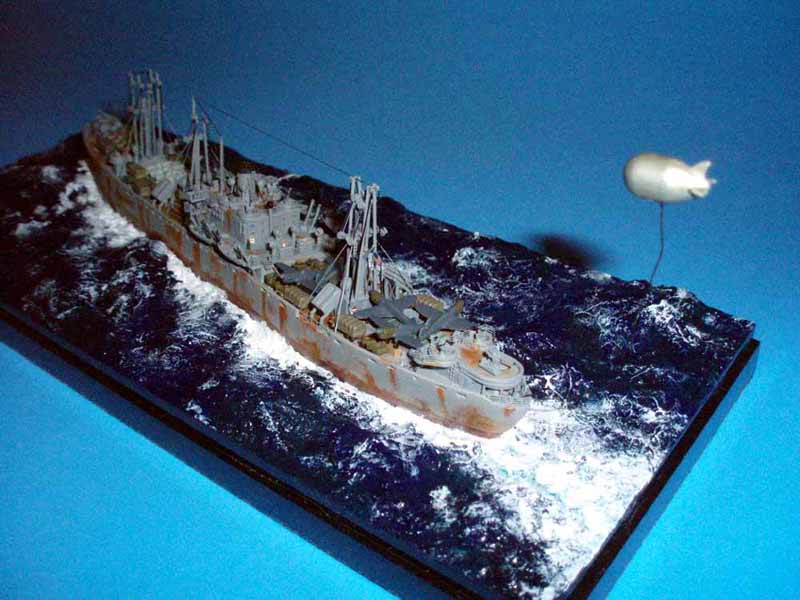
1/700 SS John Randolph (Skywave)
The SS John Randolph was one of 2,710 Liberty ships completed during the frenzied U.S. shipbuilding programs of World War II. Of those, 253 were lost - sunk by enemy action or from the normal hazards of being at sea, a numbing 9 percent loss rate.
She was a standard EC2-S-C1 cargo vessel, laid down on July 15, 1941, and launched with little fanfare on Dec. 30. By May she was in eastbound Convoy PQ-16 as one of the first Liberty ships to make the dreaded convoy run to Murmansk, Russia. From May 24-30, 1942, German aircraft made 245 bomb and torpedo attacks against PQ-16, sinking eight and damaging four out of 36 merchant ships. The John Randolph’s luck ran out on the trip back. On July 5, 1942, while transiting the Denmark Strait near Iceland, westbound Convoy QP-13 ran into an inaccurately charted Allied minefield. The John Randolph was one of four ships lost; five men died. She lived less than five months, but in that time did her duty, ferrying vital supplies for the war effort. I singled out the John Randolph because she seemed like a representative and nominally historic Liberty ship.
The plastic kit (No. SW2500) is Skywave’s 1/700 scale Liberty ship; actually it’s the navalized version of a Liberty ship. The model itself goes together fairly quickly and cleanly, but as usual I took the roundabout way. The scuppers along the sides of the hull had to be bored out with a No. 75 drill. As did the portholes, and new portholes had to be added in the correct places. Then there was the weird armor plating. Liberty ships were built fast and cheap; steel was not something to be wasted. Swiping an idea from the British, the U.S. added extra armor around the bridge/radio room and gun tubs with the same stuff you surface roads with - asphalt. Mixed with granite chips. And held in place with metal bands and metal fasteners. Thin strip styrene and disks created with my Waldron miniature punch-and-die set helped simulate that feature.
I wasn’t able to find out what the John Randolph carried as deck cargo on that first Murmansk run so I threw in a little of everything! One thing about the Liberty ships, anything and everything was piled on top once the holds were full. I found photos of Libertys carrying locomotives, landing craft, semi-trucks, a tugboat (seriously) and anything else you could think of.
I settled on Navy Aggressor Gray (Model Master 1994) as the main color and spray painted the hull, decks and superstructure at the same time. To break things up color-wise, the P-40s were painted in dark gray Schwarzgrau RLM 66 (Model Master 2079) to simulate the protective coating that airplanes riding as deck cargo got. Other small deck and ship equipment items were painted Dark Gull Gray (Model Master 1740) to make them stand out a little. The Lend-Lease “Russian” GMC trucks were painted Afrika Corps khaki (Model Master 2098) to set them apart from the other vehicles. The halftracks, jeeps and weapons carriers were painted several shades of olive drab. Hatch covers were painted RAF Interior Green (Model Master 2062), but a couple were darkened with brown paint to indicate “newer” canvas; all were then weathered with a light wash of acrylic black paint to simulate wear and tear.
Weathering the ship to make it look rusty and abused was done mostly with drybrushing. I did not use my Rustall weathering set because quite honestly, I’ve never been able to get a really thick coat of rust on something with it. The colors I used were Testors rust (1185), flat brown (1166) and orange (1127) and Model Master Rust (1785). Of those, the flat brown looked the most like rust when it was drybrushed on the decks or streaked down from the scuppers along the sides of the hull. Using the different shades and sometimes overlapping them helped give the uneven appearance of real rust. The orange was used in only a few spots, very tiny dots to represent fresh rust, which once dry was drybrushed over with one of the brown shades to mute it down. After I “rusted” the decks, I masked off several areas and painted them a different shade of gray to make it look like the deck crew was at least trying to stay ahead of the problem.
I made only one major structural modification. I wanted my ship to be listing wayyyy over to one side, so I glued a strip of 0.125-inch sheet styrene along half of the hull lengthwise after roughly shaping it, then smoothed out the joint with Tamiya putty and sanding sticks and painted the new plastic red (Floquil Boxcar Red 110074) to represent the below the waterline hull. When all was done, it gave the model a pronounced list to the right.
The other major challenge for this model was water - for the first time, I was going to try and put a waterline model on an “ocean” base ... and naturally I wanted to make it harder by trying to model the big waves of the stormy North Atlantic. There are tons of how-to’s about this on the Web; I opted for the acrylic gel medium version, painted with acrylic paints.
Before I started on the waves I cut a template of the bottom of the hull out of some thick plastic stock, so I could sculpt the waves around that shape without having to worry about getting acrylic gel on the model. I did not, as some suggest, coat the entire finished surface with Future floor wax to give it a glistening shine - to me it looked fine as it was, with Future drybrushed over random patches. As you can see from the pictures, it turned out OK - for a first effort!
When the model was almost done I decided to add a barrage balloon. Some were included with the Skywave Beachhead Vehicles set, I found pictures of Murmansk convoys using them, so I figured what the heck. The only question was, how were they rigged? Research revealed that, you guessed it, no one was really sure. A Liberty ship volunteer in San Francisco said it looked like a cable was run from one of the winches at No. 5 hatch to a pulley on the No. 3 kingpost and then to a bracket on the top of the mast ... which wasn’t going to work for me because the display case I bought only had a couple of inches of clearance at the top. So I compromised and added a hawser reel to the stern. A length of 30-gauge wire proved sturdy enough to hold the plastic barrage balloon. The balloon was painted with aluminum (Testors 1181) to mimic the aluminum-doped fabric of the real balloons. Although not “scale” as far as the length of the cable goes (2 inches [117 feet] instead of 17 inches [1,000 feet]), it still looks pretty cool with the clear plastic display case top in place. Other little insane detailing bits included:
- Scratchbuilding the lifeboat davits out of plastic rod, and then gluing the lifeboats on so they hung at the correct angle to reflect the ship’s roll to starboard (lifeboats were always kept swung out in combat areas, for a quicker escape);
- Cutting the wheels off the four trucks on No. 1 hatch, and replacing them with plastic disks created with my Waldron punch set to look more realistic; the rest of the trucks had a square gap filed in the solid front and rear wheels so they would look more three dimensional.
- Adding a short piece of round plastic rod to the left side of most of the 20mm cannon to represent the ammunition drum;
- Painting olive drab “canvas covers” over the engines of some of the P-40s;
- Adding cable stays to the funnel (but not all 8, not enough room!);
- Drilling out the spaces between the webbing in the bottoms of the six rectangular rafts on the aft superstructure;
- Drilling out the waste discharge ports on the port side at the waterline;
- Adding some soot stains to the top of the superstructure mast, to reflect the coal-fired propulsion of Liberty ships;
- Adding a rim around the anchor hawse holes with 30-gauge wire formed around the correct sized drill bit.
Is this an exact replica of the John Randolph on that first Murmansk run? Of course not. I missed some details (filling in the aft bulwark cutouts, for instance) and some things I had no way of finding out, like what her deck cargo load was for that trip. When all is said and done, however, this model is a faithful representation of a Liberty ship doing what it was designed to do - hauling the “bullets, beans and bandages” that our fighting men needed across the oceans of the world. Here is a fairly complete list of all the added bits:
Gold Medal Models
- Photoetched fire hose racks and watertight doors for all decks, deckhouses, etc. (No. 700-22).
- Forward draft marking decals (No. 700-1D). I forgot the aft ones ...
- American flag decal (No. 700/350-1D).
- Red star decals for some GMC trucks (No. 700-3D).
Tom’s Model Works
- Used most of the Liberty ship photoetch set (No. 708); the liferaft racks defeated me, so I used the bracing from the PE fret with the kit’s plastic racks. The boom collars were too small for the .025 plastic rod I used for booms.
Skywave/Pit-Road
- 20 2 1/2-ton GMC trucks, 5 Dodge weapons carriers, barrage balloon and white star decals for some vehicles (Beachhead Vehicles, kit SW-400).
- Extra anchor at No. 5 hatch, hawser reel at stern, 4 oval life rafts (Equipment for U.S. Navy Ships WW II, kit SW-1000).
White Ensign Models
- 2 White halftracks (No. DM-7043).
- 4 Willys jeeps (no longer made).
- 5 P-40 fighters (No. WEMAS-7162) with photoetch landing gear (No. PE-715). Propellers, wingtips and stabilizers were usually removed and crated separately for aircraft carried as deck cargo, which is how I depicted mine.
- 5 25-foot motor launches (No. PRO B011), bought for another idea that didn’t pan out.
- Photoetched oars for forward lifeboats and tillers/rudders for aft lifeboats (No. PE-739).
Loose Cannon Productions
- 8 lifeboat falls from leftover photoetch.
Evergreen Scale Models
- Various sizes styrene for scratch building (No. 100, 101, 175, 211, 219, 9002, 9009).
- Deck cargo of pipe (No. 221), with the ends bored out with a No. 80 bit, painted steel (Testors 1180), weathered with Rustall and glued into pyramidal stacks.
Imex Model Co.
- Display case, No. 2510. I like these because they are cheap, stackable and the clear plastic is fairly distortion free.
One final note about the U.S. Merchant Marine in WWII - a lot of people at the time characterized them as slackers, draft dodgers, or worse. But when all the numbers are added up, the Merchant Marine had a higher casualty rate than any branch of the U.S. armed services, including the Marines. In 1942, at the height of the Battle of the Atlantic, 4,985 Merchant Marine and Armed Guard died at sea - a rate of almost 100 men per week.
Today there are only two Liberty ships in their original World War II appearance, the S.S. Jeremiah O’Brien at San Francisco and the S.S. John W. Brown at Baltimore. Both are fully operational and go out on regular cruises. The others are all gone.
