by Bob Nandell
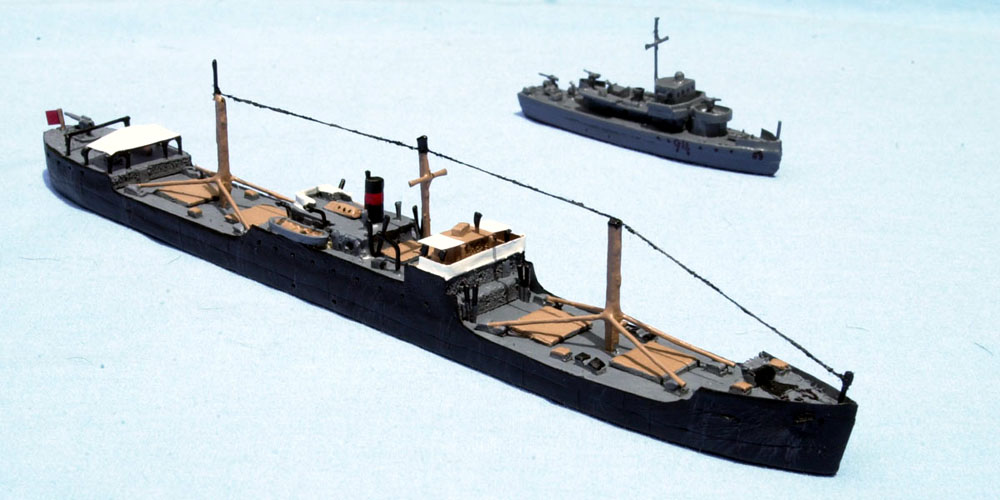
1/700 HMS Thistleglen (Scratchbuild)
I became curious about HMS Thistleglen, a British steamer built in 1929, while reading Marc Milner's book North Atlantic Run (1985) Naval Institute Press, and references from J. Rohwer and G. Hammelchen's Chronology of the War at Sea (1992) Naval Institute Press.
The unfortunate 4748 ton, 12 knot, triple expansion steam-engine-powered ship was hauling 2400 tons of pig iron and 5200 tons of steel as part of slow convoy SC42 in the North Atlantic on 10 Sept.,1941 when, at 1640 hours she was torpedoed by U85 and quickly sank, taking three crew members with her.
Ships like the Thisleglen, and the U.S. Liberty and Victory type ships, are all over the place in the blurry background of grainy WWII black and white convoy photos, and flotillas in the background of beach invasions. They all took part in the grimy, dangerous, mostly unseen backwaters of the supply chain that gave the Allies eventual victory.
My depiction of the Thistleglen, pressed into war service in 1940 still in her civilian paint livery, is constructed of balsa, paper, sheet plastic, and a raid on the parts box for the ship's boats and the stern gun.
