by Jim C. Smith
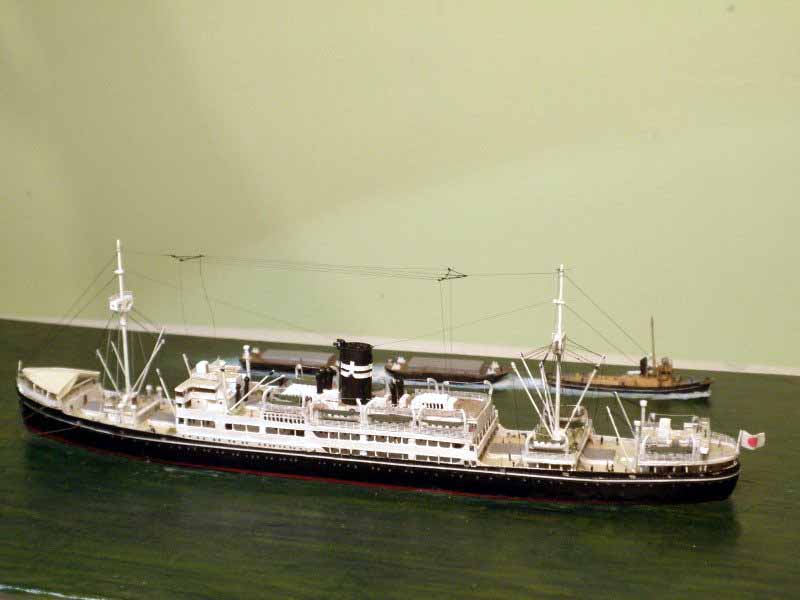
1/700 Rio de Janeiro Maru (Pitroad)
Here is another of my Japanese Liners from the pre-war period. This is the Pit Road resin kit, which is now rather hard to come by. My thanksgo to HobbyWorld Japan for this one.
Rio de Janeiro Maru was built by Mitsubishi Shipyard - launched on 19 November 1929 and delivered to her owners Osaka Shosen Kaisha (OSK) as sister ship to Buenos Aires Maru on 15 May 1930.
She was 9,627 tons, 473 feet long and 62 feet beam. The two ships conducted round the world trips, westbound from Japan via South Africa and South America.
Rio de Janeiro Maru became a submarine tender in 1941 and mounted four 5.9” (150mm) guns. She was sunk at Truk Atoll on February 17, 1944 during one of the Operation Hailstone raids.
In common with other resin kits I’ve done the main components are fairly well detailed. This kit is supplemented with white metal components (ventilators, boat davits, guns – if required), brass rod for masts and derricks. However, the first thing that you need to do with this kit is to decide whether you are going to detail by cutting the between deck stanchions (100 plus of them!!). This took rather a long time and was pretty ‘fiddly’. I eventually compromised by cutting them twice the size and drilling through 2 decks.
Another feature of the ship was a large awning frame on the forecastle (not required if you model it as a sub tender as it is replaced by a 5.9” gun on a bandstand). I constructed this using 0.03mm brass wire (next time I’ll use 0.01) and covering with wet cigarette paper, painted off-white (Rizla ‘Blue’ – thanks to Rob K for that tip!).
Construction was pretty straightforward until it came to the masts. This time I used the BMK tapered masts supplied by Battlefleet Models. Working from a photo of the ship at Cape Town, I decided that I would try to make the crosstrees to aid the rigging process. These were cut from Evergreen sheet and drilled (it took several attempts to get them looking ‘right’ but in the long run was worth the effort). [One day we might get these in Photo etch – anyone listening?].
Rigging was a mixture of fly-tying line, caenis line and stretched sprue. Photo etch was used from GMM Merchant ships and Auxillary Ships sets and Lionroar. Figures are from Eduard Naval Personnel and Passenger sets.
The itinerary showed the ships sailed westwards from Yokohama stopping at Hong Kong and Singapore on their way round the world. I thought a ship at anchor in the green waters of a Bay/Estuary would be something different for me. The tug is from the Hasegawa set. The junk and the dumb lighters are scratchbuilt from Evergreen plastic and paper using dimensions and photos I trawled from the Internet. The sea base is Watercolour paper, painted with acrylics, enhanced with acrylic gel and given several coats of Klear (Future).
