by Don McKeand
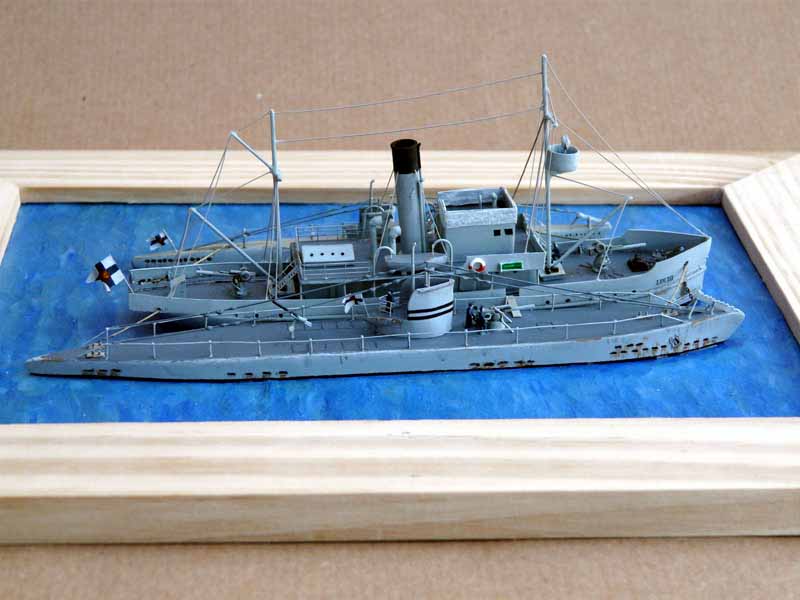
1/400 Vesihiisi, Louhi, Saukko and Vesikko Finnish submarines (Mirage/Scratchbuilt)
This little scene depicts the majority of the Finnish submarine force in the summer of 1939 in the calm before the storm of the Winter War. The Vetehinen class boat Vesihiisi (with two black bands) had two sisters, Vetehinen and Iko-Turso which are the only submarines to serve with the Finnish Navy not depicted in the scene! The smallest vessel in the scene is Saukko which displaced a mere 99 tons as there was a limit of 100 tons for vessels operating on Lake Ladoga. She was not a particularly successful design but in December 1939 she had the battleship Oktyabrskaya Revolutsia in her sights. She was prevented from attacking by her air vents freezing. The other submarine is Vesikko which was supposed to have been a private venture by the Crichton Vulcan yard, being launched in 1933, with the Finnish navy having an option to purchase. In fact the boat served as the prototype for the German UII class and was used for training and testing by German crews until the Finns finally purchased her in 1936. Acting as depot ship for them is Louhi.
For me it all started with the Mirage UIIa kit, hence the choice of 1/400 scale. The original intention was to modify the kit to depict Vesikko as she is displayed nowadays on Suomenlinna, but the hull seemed rather small and lonely. Several pictures of the pre-war submarines alongside a depot ship suggested a collection of a representative of each class, so the Mirage hull was waterlined and a new conning tower scratched.
The larger Vetehinen class submarines were built with minelaying capability, hence the wide deck casing. Very basic sketches of these boats and Saukko were available on Jari Aaromaa’s website on the Finnish Navy, and these were re-drawn to 1/400 with details added from photographs.
Louhi was an ex-Russian minelayer built in 1916, originally named M1, which also served as submarine tender. She was very active laying part of the huge mine barrages in the Baltic during the war years and was torpedoed by U370 on January 12th 1945 while sailing under Soviet direction. It had previously been thought she had been mined, but the wreck has recently been found and the damage confirms an acoustic torpedo. I could not locate any drawings of Louhi, so photographs and published dimensions were used to draw up plans.
Saukko’s hull was built on the “bread and butter” principle from different thicknesses of plastic card. Vesihiisi was built using two square section styrene tubes alongside each other as the basis of the centre section, with plastic card sides and decks added and shaped from there. Louhi was built from plastic card using the egg-box method familiar to card modellers with Milliput to get the shape of the stern. All the superstructure and details were made from plastic card and tubing with some brass tubing for the gun barrels and brass rod for the masts and booms. Figures, ladders and railings are L’Arsenal items.
