by Guido Hopp
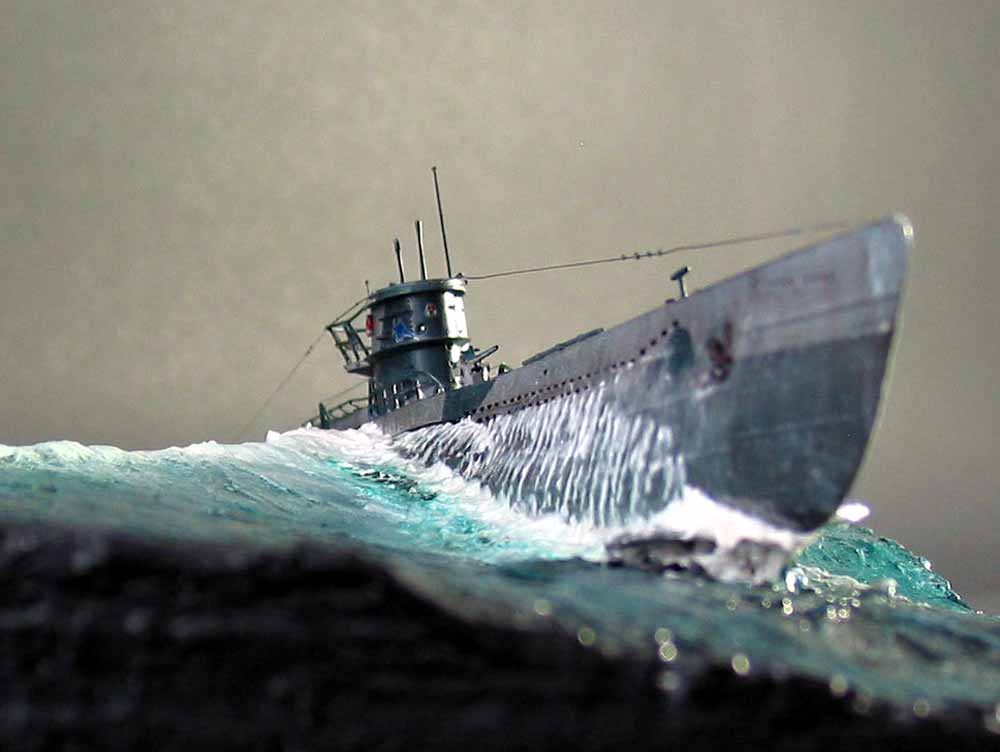
1/144 DKM U-217 Type VII-D (Revell Germany)
Hello, Fellow Modelwarshippers!
Here’s an OOB project that I started mainly to practise making water. My first subject ever set in water was featured in very calm sea. Now that is neither hard to do nor does it have a very dramatic effect. So I decided to do a model featuring the complete opposite, as to follow my credo to learn something new with every new model I make. I selected Revell’s 1/144 Type VII-D Uboat to do just that.
A total of 6 D-Type vessels -layed out especially for mine laying purposes- were build. Advancing mine designs and better incorporation of the mines into standard subs rendered this type of boat design obsolete. One of these vessels was U-217 of the 9th Uboot-Flotille. U-217 was layed down in Kiel on 30th January 1941. One year and one day later she was commissioned und integrated into the 5th Flotilla at her home port Kiel for training under command of Kptlt. Kurt Reichenbach-Klinke. By 1st August 1942 U-217 was transferred to the 9th Flotilla stationed at Brest France for active front duty. Until being sunk by aircraft of the US Carrier Bogue on 5th June 1943, she sailed on 3 patrols sinking 3 ships totalling 10,651 BRT. U-217 was sunk in the mid Atlantik by Avenger aircraft under loss of all hands.
My U-217 is marching home from first patrol. The skipper is using the aircraft free skies in this heavy weather to make speed on the surface.
The vessel is set in a deep sea of styrofoam. The waves were first cut from the block using a rotary steel brush on a dremel. The basic hull cut-out in the sea bed followed. The sea-surface was levelled using plaster first then Acrylic gel for finer structures. The seascape was painted using artists acrylics starting black with continuously lighter shades of green toward the boat and the tips of the waves. Extensive dry-brushing using light grey and white finished the colouring off. The ready assembled, painted and weathered boat (devoid any detail that might break off) was wrapped in cellophane foil. Now the hull was inserted into the seascape. The voids were filled first using plaster then white and transparent acrylic gel. When all was dry the cellophane was cut away. Some of it remained to form wave-wash around the boat. More acrylic gels, white and transparent, were used for finer fitting, wash and wave shaping. After U-217 was fitted into her surroundings, washes and dry brushing were used to blend the immediate area around the boat into the surrounding seascape. Only then the details such as handrails, antennae and wintergarten were put into place. Before adding the rigging from stretched sprue, the boat received an uneven wash of Future to create a “wet” effect.
The kit itself was a pleasure to work with: All parts fit easily and smoothly. Basically, I needed no filler at all. Removing the mould on handrails and steps around the sail was easy. They were replaced using 0.3 and 0.4mm brass wire. I added a handrail around the mine containers behind the sail. By now I am almost certain that there was none on the D-Types, even though the similar containers (with (!) handrails) were used on earlier mine laying boats. Well, I think it looks kinda cool. Too cool to remove them, anyway! All flooding holes and slits were opened on this build, which I deem essential for a good look of any of these boats in this or any larger scale. It wasn’t too difficult either.
Of cause the wintergarten came apart a couple of times before found the final resting place on the boats platform. Still I can recommend this kit to anyone, who likes subs. The scale at 1/144 gives you a quite impressive model. Revell has definitely put out a winner with this kit. Can anyone point me to a nice set of in-scale figures in wet-suits to be placed as deck-watch?
I hope you like what your see. I am looking very much forward to discussing the finer points with you on the message board.
