by Ken Hart
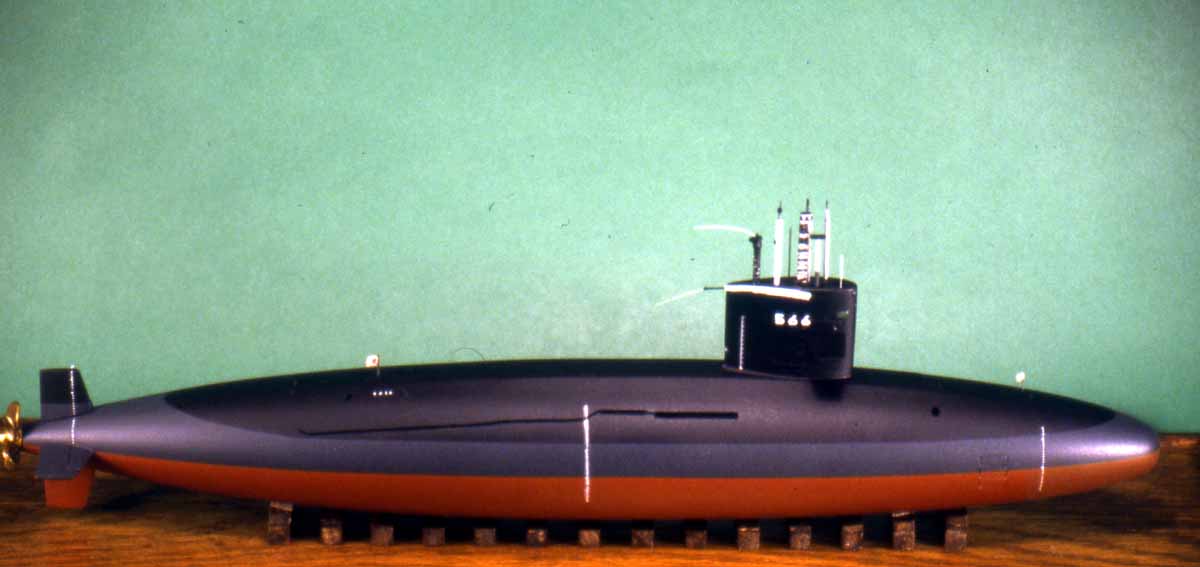
1/200 JMSDF Uzushio SS-566 (Raccoon)
Here's a set of 11 photos of a mildly unusual submarine model. I managed to get hold of this somewhat obscure resin kit from a Japanese garage industry known as Raccoon -- if not for a friend in Tokyo, I'd never have been able to find this one.
Cast in solid resin, this 1/200 scale submarine came in a Japanese-labelled box with no instructions and no decals. All the parts were cast resin, except for a few white-metal masts. The sub's hull was in two pieces, but split fore and aft rather than the usual upper and lower halves.
The quality of the casting wasn't too bad, but it wasn't too great, either. Had lots and lots of pocks and pit marks that needed to be filled in, and lots of flashing to be trimmed off. But the assembly went well, and the kit yielded a nice model of a modern Japanese diesel-electric submarine. Scrutinous research provided a necessary guide for accurate deck detail scribing, and a few brass wire railings and grab handles, a couple of whip antennae, and the Uzushio was looking pretty good.
The decals, however, were a very difficult hunt. The style of shaded numbers on modern Japanese warships are not the same cut-cornered boxy style the U.S. uses. The many draft mark numbers measured in meters, were just as elusive. Loren Perry, of Gold Medal Models, helped me find what I needed.
My friend in Tokyo also helped me find a few issues of MARU magazine, a Japanese publication dedicated to the study of their warships. From them, I gleaned all I needed to produce a workable set of drawings with scribing and placement detailings.
And that's it for the JMSDF Uzushio model. A pretty cool little modern Japanese submarine - nothing particularly special, but a bit unusual in a submarine hobbying world dominated by 688s, WWII fleet boats, U-Boats, and modern Russian subs
