by Martin Kohring
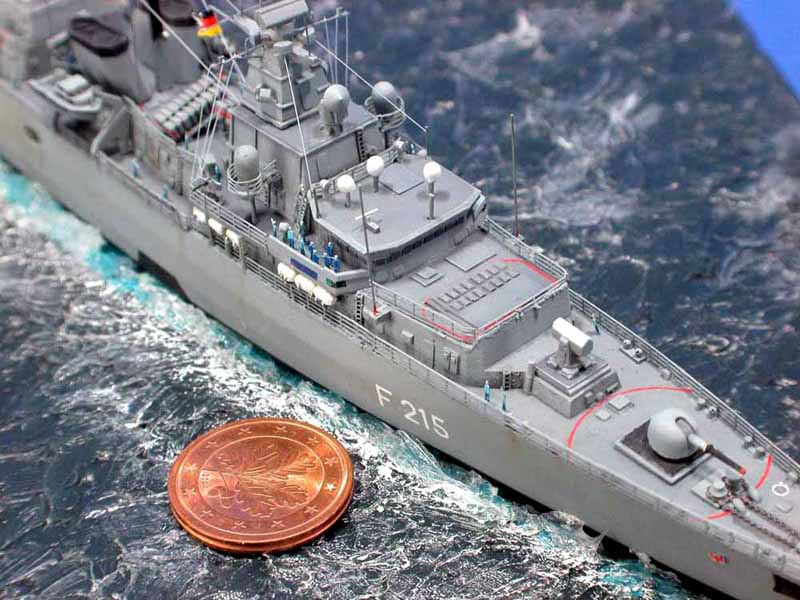
1/700 Brandenburg (NNT)
The Brandenburg-class frigates are primarily designed for anti-submarine warfare and force command and control. The two Sea Lynx shipboard helicopters are primarily used for anti-submarine operations, but are also employed for sea patrols and anti-surface warfare.
The Type 123 is equipped with efficient radar systems for surface and air surveillance, fire control and navigation. Sonar systems, situation picture and data transmission systems, electronic warfare systems and the most advanced communications technology specially designed for command and control tasks complete their array of equipment.
The Frigates of the class 123 were designated as replacement for the destroyers of the Lütjens class (Rommel, Lütjens, Molders).
The building contracts were placed on 28.06.1989 to shipyard consortium Thyssen of North Sea Yard, Blohm + Voss (consortium leader) and Howaldtswerke-Deutsche Werft AG. This marked an important step toward modernization of the German navy The class was to comprise 4 units, which carried the names states of the Federal Republic.
The ships are called. F215 Brandenburg, F216 Schleswig Holstein, F217 Bavaria nd F218 Mecklenburg Vorpommern. The first ships keel was laid 1991, launched 1992 and after an extensive trials was commissioned on 14.10.1994 . The remaining three units of the class were launched 1994 and 1995 and entered service 1995 to 1997 . The functional design, which was a nod to the previous frigate class was to be characterised by better conditions on board for the crew, better stability and simpler construction by use of modular construction methods.
To assist the building of this model, in addition to the comprehensive kit instructions, I was fortunate to be able to use the superb photos of the Brandenburg in her current fit supplied by fellow ‘IG Waterline’ member Torben Keitel ( IG Waterline = our waterline modellers association in Germany)
The model built straight from the kit would represent the model as in 1995. I wished to portray her in her present day guise, this requiring various changes and modifications to be made especially around the Bridge and Mast area as well as the the Portside launch
I primed the hull with Vallejo Grey primer.I had wanted to try out the new Revell ‘Aqual-color’ range of acrylic waterbased paints. The hull was sprayed with Revell 57 from this new range - these can be thinned with water; however for even better results I thinned them Alcohol.
The helideck and all horizontal surfaces were then hand painted using Revell 74.
Brandenburg in the fit I chose to depict her in had, above the boot-topping, trapezoid black shapes around the cooling-water discharges. These and the boot-top were masked with Tamiya tape and airbrushed with ‘AquaColor’ black
Many modern ships have extensive markings—which in model kits are usually represented in the form of decals which have a glossy carrierfilm. To avoid this being visible-silvering-with minute airbubbles when applied to a matt paint such as the airbrushed Revell 57 I applied a coat of Aqua-color Revell 01 glosscoat prior to decaling. Afterwards I sealed these with another coat of the 01. befor flatcoating the finished model.
The kit contains a PE fret for some of the small detail; I merely needed to aquire some suitable railing. I used the 3-bar set from Saemann , affixed with CA gel.
I applied most of the railings prior to the painting stage to minimise joints and seams.
Fiddly parts in particular were the liferaft canisters and their photo-etched cradles.
Having lost some of these brackets, I thereafter used UHU glue to tack the cradles to the liferaft first-and thereafter applying the whole assembly to the ship! Care should be taken as the CA and the UHU make a sticky bond-which can make the assembly even more difficult!
The Helicopter was miniature model kit in itself….two resin parts and PE for the rotors, the windows being picked out with a black Fineliner pen. The black rotors had fine yellow lines applied whilst the aft rotor was panted in red and white. The insignia was furnished by Pitroad, with the German colours being handpainted.
With such a small model I had to accentuate the shapes to prevent it appearing too monotone and flat. I applied a highly thinned wash of oil over the surface relief detail to give the impression of shadows.. This technique was applied in a concentrated fashion particularly in the region of the ladders-on the real ship the area behind the ladders are painted in a darker grey! A bit of subtle drybrushing elicited the shapes most effectively.
Modells of the present day German Bundesmarine are few and far between.
NNT has announced its attention to create further models of he German Navy in the future. I thoroughly enjoyed building this kit in 60 hours or so without a moment of boredom.
I wish to extend my thanks to Torben Keitel for the superb photos of the real ship and Norbert Thiel of NNT Models who speedily replaced my lost liferafts and never-to-be-seen-again tiny PE parts…
