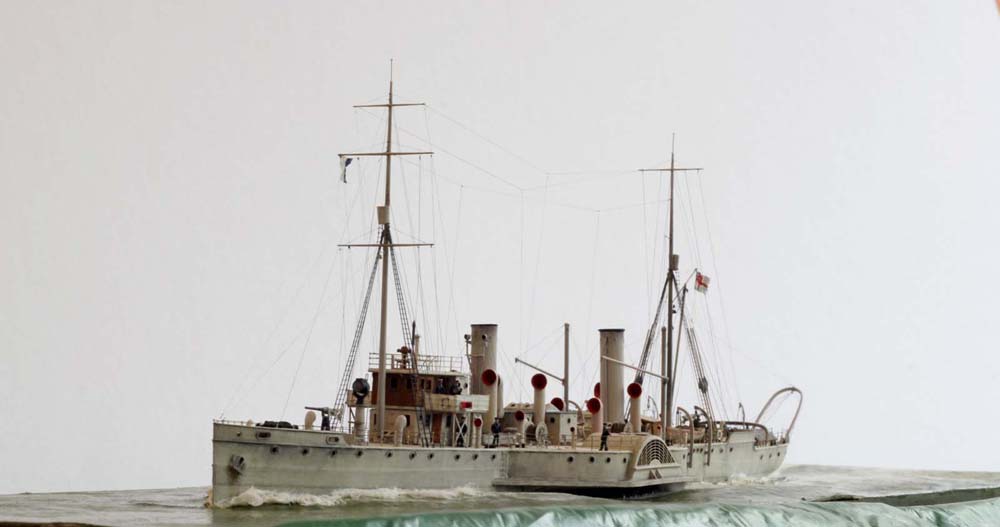
1/350 HMS Atherstone 1916 (AJM Models)
|
by Jim Baumann |
1/350 HMS Atherstone 1916 (AJM Models)
HMS Atherstone was part of the first phase of the extensive 'Racecourse' class of paddle minesweepers built for the Royal Navy in WW1. Her builders, Ailsa SB at Troon in Scotland, launched her on 14 April 1916. For the remainder of the war she served with the Auxiliary Minesweeping Patrol. At 823 tons displacement, HMS Atherstone was 235 ft loa ; her coal-fired boilers producing 1400 hp to give her a service speed of 15 knots. She was operated by 52 officers and men, she carried defensive armament of 2 x 12 pdr Q/F guns for and aft. Her impressive beam of 58 ft at the paddle boxes made a stable and powerful minesweeping platform, though in rough weather and high waves the paddle-boxes could get clogged with water, impeding propulsion and possible stalling and consequent damage to the steam machinery.At the end of WW1 she was transferred to the Mine Clearance Service. With peace returned and minefields cleared, HMS Atherstone was sold to 'The New Medway Steam Packet Company 'on 12 August 1927,and converted to an excursion passenger steamer for scheduled workings on the Medway and Thames and renamed Queen of Kent. For the next twelve years she could be found working from Sheerness and Southend. Regular excursions took her to Gravesend, Margate, Clacton and Dover as well as cross-channel voyages to Calais, Boulogne and Dunkirk.
In September 1939 at the outbreak of WW2 she was requisitioned by the Admiralty once again for minesweeping duties and commissioned as HMS Queen of Kent, pennant number J74. For Operation Overlord in June 1944 she was stationed at Peel Bank off the Isle of Wight as the Mulberry Accommodation & Despatch Control Ship,subsequently she was stationed at Dungeness on the south-east coast. After the war she was returned in 1946 to her Medway Steam packet owners to recommence her excursion work around the Thames Estuary.
In January 1949 she was sold to Red Funne Lines and transferred to Southampton. After extensive refitting at Thorneycroft's yard at Northam, Southampton she was commissioned in the spring of that year as the company's second ' Lorna Doone'. For the next three years she operated excursions trips from Bournemouth Pier in the summer. She was finally withdrawn and scrapped by Dover Industries Ltd at Dover Eastern Docks in 1952.
My model of this fine ship is based on the resin kit from AJM Models, the Companys first release. The models overall dimensions are good, and the appearance is well captured. The kit suffered a few minor errors which are easily corrigible, and one more significant flaw, in having no sheerline( deckspring ) fore-and-aft. I cured this by the simple expedient of building up the underwater area for and aft and then drawing the centre of the hull down with two screwed nuts and bolts into the base, so as to be able to adjust and tune the sheerline by simply drawing up and releasing the two screws-which once the desired sheerline was achieved had the screws glued solid. I eschewed much of the KIT PE for finer ( and more fragile !! ) PE from WEM and Alliance Modelworks.
The 2 x 12 pdr Q/F guns were scratch-built and much of the superstructure was enhanced and refined. A detailed description of most aspects of this model build and the corrections, and my solutions to issues overcome so as to reach the presented resultant model, can be found right here in the forum on Modelwarships.com
A future project is to build the same ship again--in 1/700 using again the AJM kit of the 'Queen of Thanet' in that scale,as the Red funnel ship ' Lorna Doone' in the latter years of her pleasure steamer career. Nothing in life--or modelmaking.... is perfect--it would be too easy otherwise ! Nevertheless I am pleased with the the overall model and I do applaud and commend AJM Models for tackling a very deserved but often overlooked subject in resin.
